
The Anatomy of a High-Quality B2B Cold Email
Introduction
Two representatives can send a B2B cold email to the same prospect on the same morning and get very different results. One message is deleted in seconds because it spends three paragraphs describing the sender’s company. The other earns a short reply because it is clearly written for the person reading it. In most cases, the difference is not cleverness. Instead, it comes down to structure.
A high-quality B2B cold email is not a trick, a template to be copied or a guarantee of a response. It is a short, relevant and respectful message that gives a busy buyer a reason to reply. Understanding its parts helps a team write, review and improve outreach consistently.
For B2B technology, IT services, SaaS, AI and cybersecurity teams, use the six parts below as a practical starting point. They sit within a wider repeatable sales development process, which shows where outreach fits in the pipeline.
Why B2B cold email quality matters for sales leaders
Every cold email speaks for your company to someone who has never heard of it. When each representative write Equally important, follow-ups should provide additional value. ites differently, good accounts get weak first impressions and leaders cannot tell which messages work. Careless sending adds risk: complaints, a damaged sender reputation and legal exposure. A shared standard for B2B outreach turns individual habit into something a leader can review, coach and measure.
The six parts at a glance: an annotated B2B cold email
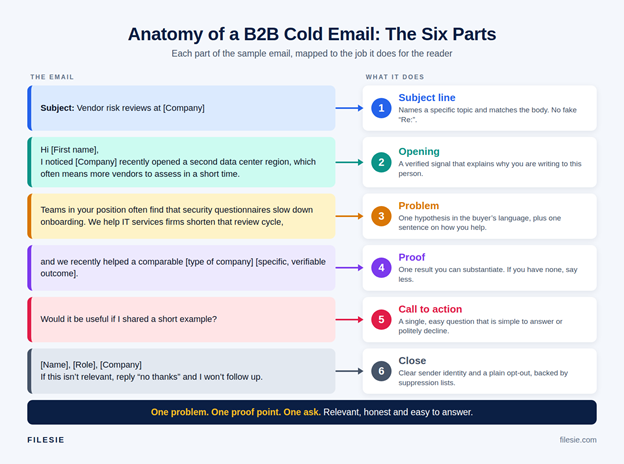
Here is a short illustration, with placeholders in brackets. Replace each one with something you can verify.
Subject: Vendor risk reviews at [Company]
Hi [First name],
I noticed [Company] recently opened a second data center region, which often means more vendors to assess in a short time.
Teams in your position often find that security questionnaires slow down onboarding. We help IT services firms shorten that review cycle, and we recently helped a comparable [type of company] [specific, verifiable outcome].
Would it be useful if I shared a short example?
[Name], [Role], [Company]
If this isn’t relevant, reply “no thanks” and I won’t follow up.
The email maps to the six parts explained next:
- Subject line: names a specific topic.
- Opening: a verified signal explains why this person.
- Problem: one hypothesis in the buyer’s language, plus one sentence on how you help.
- Proof: one result you can substantiate.
- Call to action: one easy question.
- Close: clear sender identity and a plain opt-out.
1. A B2B cold email subject line that sets honest expectations
Keep the subject line short, specific and consistent with the body. Refer to a topic the recipient will recognize, not a vague promise or manufactured urgency. Fake “Re:” prefixes and misleading claims may win an open, but they cost trust and can breach anti-spam rules.
Compare how these set expectations:
- Clearer: “Vendor risk reviews at [Company]” or “Question on your SOC 2 timeline”
- Weaker: “Quick question!!!” or “Re: our conversation” when there was no conversation
When testing variations, change one element at a time and judge results by replies and meetings, not opens alone, because open data can be unreliable.
2. A B2B cold email opening that explains why this person
The first line should show why you are writing to this individual. Connect to their role, their company’s situation or a verified signal, such as expansion, hiring, a product launch or a changing regulatory requirement. Personalization should make the message more relevant, not merely insert a name or mention a recent post.
If you cannot find a genuine reason to contact the person, the answer is more research, not a more flattering opening line.
Effective personalization connects an observable business development to a plausible challenge the recipient may need to address. Learn more about how cold email turns target accounts into sales conversations and how targeted outreach helps build meaningful B2B relationships.
3. A clear problem, not a product tour
Name one plausible business issue in the buyer’s own language, in a sentence or two. Treat it as a hypothesis rather than an assertion: “Teams in your position often…” invites the reader to correct you, which is a better start than assuming you know their priorities.
Follow with a single sentence on how you help. Resist the urge to list features, certifications and service lines.
4. Proof that is specific and verifiable
Include one piece of relevant evidence: experience with a similar type of company, a concrete outcome you can substantiate or a short example of how a comparable problem was addressed. Claim only what you can support. Where confidentiality prevents naming a client, describe the context honestly rather than inflating the result.
If you do not yet have proof for this segment, say less. A modest, accurate statement of relevant experience is more credible than a sweeping claim the reader cannot check.
5. One low-friction call to action for every B2B cold email
Make a single, easy-to-answer request that matches the level of trust you have earned. “Would it be useful if I shared a short example?” is often easier to answer than a request for thirty minutes on a calendar. Multiple asks dilute the message and make a reply harder.
A good call to action also makes it easy to decline. A prospect who can say “not now” politely is more likely to engage later than one who feels pressured.
6. A respectful close and a compliant foundation
End with a clear signature showing your name, role and company, so the sender is easy to verify. Include a simple opt-out, honor requests promptly and keep suppression lists current. Follow the rules of the markets you serve, such as CAN-SPAM in the US, GDPR and national e-privacy rules in Europe and CASL in Canada, and confirm your approach with legal counsel.
Adapting the B2B cold email structure to other situations
The same six parts work when the trigger changes. Two short variations for a sales prospecting email:
Subject: [Mutual contact] suggested I reach out
Hi [First name], [Mutual contact] mentioned that [Company] is reviewing how it handles [problem]. We recently helped a comparable [type of company] [specific, verifiable outcome]. Would it be useful if I shared a short example?
Mention a referral only with the referrer’s permission.
Subject: Scaling the security team at [Company]
Hi [First name], I saw [Company] is hiring several security analysts. Teams growing this quickly often find that alert triage absorbs new hires’ time before they can focus on higher-value work. [One sentence on how you help.] Would a short walkthrough be useful?
Follow-ups that add something new
Use a documented sequence with sensible spacing and clear stop rules. Make each follow-up add a relevant example or a different angle, not a reminder that the first email was sent.
What leaders should standardize
Strong outbound sales results depend less on individual flair than on a few shared decisions:
- An approved ICP and the buying signals that justify outreach.
- A bank of verified proof points, with permission to use each one.
- A review step before a new sequence goes live.
- Clear ownership of opt-outs, suppression lists and compliance checks.
- A small set of metrics reviewed together: positive replies, meetings held, qualified opportunities, and complaints or unsubscribes.
A B2B cold email best-practices checklist
- Confirm the recipient fits your ICP and that there is a specific reason to contact them now.
- Check that the subject line accurately reflects the content.
- Keep to one problem, one proof point and one ask.
- Read the email on a phone and remove any sentence that does not help the reader decide.
- Include sender identity and an opt-out, and apply suppression lists before sending.
- Track replies, objections and meetings booked by message variant, and review them on a regular schedule.
The strongest B2B cold email is not the cleverest one. It is the one that is relevant, honest and easy to answer, and that a team can review and improve without relying on one person’s instinct. Start with a clear structure, learn from the replies and objections you receive, and refine the message as your market knowledge grows.
Want your outbound emails to earn more relevant replies? Book a sales development strategy call with Filesie to discuss your target accounts, messaging, qualification criteria and pipeline goals.
Frequently asked questions
What are the key parts of a B2B cold email?
A specific subject line, an opening that explains why you are writing to this person, one clear problem, one piece of verifiable proof, a single low-friction call to action and a respectful, compliant close.
How long should a B2B cold email be?
Short enough to read in a few seconds on a phone. A few brief sentences are usually sufficient, but test length against reply quality for your own audience rather than following a fixed number.
Is a cold email the same as spam?
No. A cold email is unsolicited but targeted, relevant and compliant. Spam is indiscriminate or deceptive. Legal requirements differ by country, so check the rules in each market you contact.
How many follow-ups should a sequence include?
There is no universal number. Use a documented sequence with sensible spacing and clear stop rules, make each follow-up add new value and adjust based on your own response data.