
How to Find Decision Makers at IT Companies
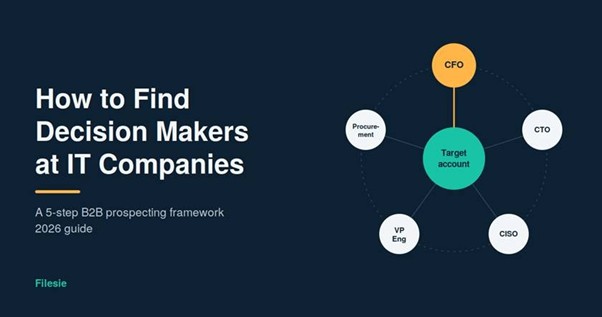
How to find decision makers at IT companies is an important part of successful B2B lead generation. Start by mapping the buying committee, identifying relevant executives on LinkedIn, enriching their profiles through reliable B2B contact databases, verifying business email addresses and approaching them with personalised outreach. When done in the right order, B2B prospecting becomes more focused and helps your sales team connect with the people who influence purchasing decisions.
Why Finding Decision Makers at IT Companies Matters
Imagine a cybersecurity company investing 18 months and $400,000 in B2B lead generation. Its marketing dashboard looks promising: 4,000 contacts generated, 600 engaged prospects and 40 meetings booked. However, only two deals convert into revenue.
What went wrong? Most meetings were with engineers and analysts who understood the product but lacked the authority to approve the purchase.
This highlights a common challenge in lead generation for IT companies: generating leads is relatively easy, but reaching the right decision makers is difficult.
In technology purchasing decisions, multiple stakeholders are involved. The CTO may evaluate technical compatibility, the CISO may assess security risks, the CFO may approve the budget, and the VP of Engineering may influence the final selection.
That is why successful lead generation strategies begin with identifying the people who influence purchasing decisions. A lead is not simply someone with a business email address. It is a relevant prospect with the authority, influence or responsibility to move a purchase forward.
How to Find Decision Makers at IT Companies: A 5-Step Framework
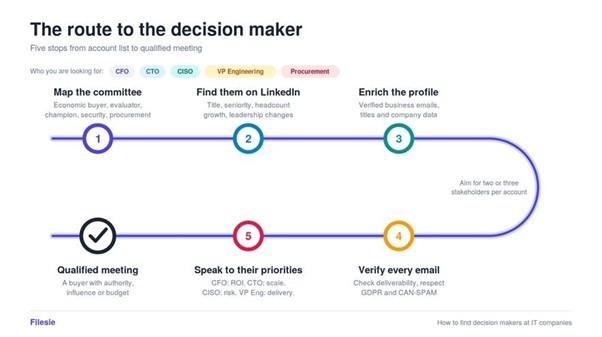
An effective B2B sales prospecting strategy follows five essential steps:
MAP → IDENTIFY → ENRICH → VERIFY → ENGAGE
Step 1: Map the Buying Committee
Before searching for contacts, understand who participates in the purchasing process. In IT companies, decision-making responsibilities are often distributed across different roles.
- Economic Buyer: CFO, CEO or business head responsible for approving budgets.
- Technical Evaluator: CTO, IT Director or Solutions Architect responsible for evaluating technical requirements.
- Internal Champion: VP of Engineering or department head who supports the solution.
- Security Stakeholder: CISO or security director responsible for evaluating risks.
- Procurement Stakeholder: Procurement manager responsible for vendor selection and purchasing procedures.
The relevant decision makers depend on your product or service, company size and sales cycle. For example, a cybersecurity solution may require approval from the CISO, CTO and CFO, while a software development service may primarily involve the CTO, CIO or VP of Engineering.
Understanding these roles helps you build a more targeted prospect list.
Step 2: Finding IT Decision Makers Through LinkedIn Prospecting
LinkedIn is one of the most useful platforms for identifying professionals working in IT companies. You can use LinkedIn Sales Navigator to narrow your search based on:
- Job title and seniority
- Industry and company size
- Department and job function
- Company headcount growth
- Recent job changes
- Geographic location
For example, if you offer cloud infrastructure services, you can search for CTOs, CIOs, IT Directors and Heads of Infrastructure at technology companies.
Pay attention to recent leadership changes, company announcements and executive posts. A newly appointed CTO may be evaluating existing technology systems or planning new initiatives, making this a useful opportunity for relevant outreach.
The objective of LinkedIn prospecting is not simply to collect profiles. It is to understand who your potential buyers are and what matters to them.
Step 3: Finding Decision Makers Using a B2B Contact Database
LinkedIn helps identify decision makers, but finding their professional contact information can require additional research. This is where a B2B contact database becomes useful.
These platforms can help businesses discover:
- Professional business email addresses
- Company contact information
- Job titles and designations
- Company size and industry
- LinkedIn profile links
- Department information
Cross-check important records using multiple reliable sources before adding them to your outreach campaigns. A smaller list of relevant prospects is often more valuable than a large database containing outdated or irrelevant contacts.
Step 4: Verifying Decision Maker Email Addresses
Finding an email address does not guarantee that it is active or deliverable. Sending campaigns to unverified contacts can increase bounce rates and negatively affect your sender reputation.
When searching for CTO email addresses or other executive contacts, follow a verification process:
- Identify the executive’s professional email address.
- Check the company’s email format.
- Cross-reference the contact using reliable data sources.
- Use an email verification tool to check deliverability.
- Remove invalid and risky addresses before launching campaigns.
Businesses conducting international B2B outreach should also consider applicable data protection and email marketing regulations, including GDPR and CAN-SPAM. Build appropriate compliance checks, opt-out processes and data-handling practices into your outreach workflow. This is general information, not legal advice; consult qualified legal professionals about your specific campaigns.
Step 5: Engaging IT Decision Makers Through Personalised Outreach
Identifying and verifying decision makers is only part of the process. The next challenge is getting their attention. Avoid sending generic messages that simply introduce your company and list its services.
Instead, connect your message to the prospect’s business priorities:
- CTO: Technology infrastructure, scalability and system performance.
- CISO: Cybersecurity, data protection and compliance.
- CFO: Cost optimisation, operational efficiency and ROI.
- VP of Engineering: Development productivity, team performance and delivery timelines.
Combine email, LinkedIn and phone outreach where appropriate. A personalised message that addresses a genuine business challenge has a stronger foundation than a generic sales pitch.
How to Choose the Right B2B Data Providers
B2B data providers help sales and marketing teams discover relevant business contacts. However, not every platform offers the same level of data quality. Before selecting a provider, evaluate the following criteria:
Evaluation criteria | What to check |
Data accuracy | Email bounce rates and verification methods |
IT role coverage | Availability of CTO, CIO, CISO and VP Engineering contacts |
Data freshness | How frequently contact records are updated |
Compliance | Data sources and opt-out management |
Integration | Compatibility with your CRM and sales tools |
Before purchasing an annual subscription, consider testing a sample of 200 records from shortlisted providers. Compare email deliverability, contact accuracy, job-title relevance and company information. This will help you make a more informed decision.
IT Lead Generation Signals That Reveal Buying Intent
A job title tells you who the decision maker is. Buying signals help you understand when to approach them. For IT companies, some useful prospecting signals include:
- Leadership Changes: A newly appointed CTO, CIO or CISO may review existing technology vendors and business processes.
- New Job Openings: Hiring for cloud engineers, cybersecurity specialists or software developers may indicate upcoming technology investments.
- Funding Announcements: Recently funded companies may have new budgets for technology, infrastructure and business expansion.
- Technology Migration: Announcements about cloud migration, digital transformation or infrastructure upgrades can reveal potential service requirements.
- Regulatory and Compliance Requirements: New compliance obligations may create demand for cybersecurity, data protection and technology consulting services.
Combining these signals with a relevant contact database makes IT lead generation more targeted and timely.
B2B Lead Generation Metrics That Matter to CXOs
Successful lead generation should be measured through business outcomes, not just the number of contacts generated. Here are five metrics worth tracking:
- Decision-Maker Penetration Rate: Measures the percentage of target accounts where your team has identified relevant decision makers.
- Sales-Qualified Meetings: Tracks how many meetings involve prospects who match your ideal customer profile and have genuine business potential.
- Pipeline Velocity: Measures how quickly opportunities move through the sales pipeline.
- Customer Acquisition Cost (CAC): Measures the total cost involved in acquiring a new customer.
- Data Decay Rate: Business contact information changes over time as employees switch jobs, change designations or leave organisations. Regular database updates help maintain contact accuracy.
Pipeline Velocity formula: (Number of Opportunities × Average Deal Value × Win Rate) ÷ Sales Cycle Length
Tracking these metrics helps businesses understand whether their B2B lead generation strategy is contributing to revenue growth.
Frequently Asked Questions
How do I find a CTO’s email address?
Start by identifying the CTO through LinkedIn or the company’s official website. You can then use reliable B2B contact databases and email verification tools to find and validate their professional email address.
Is LinkedIn prospecting effective for IT companies?
Yes. LinkedIn helps identify executives, department heads and other professionals based on their job titles, industries and company profiles. It is a useful starting point for targeted B2B prospecting.
What is the best way to generate B2B leads for an IT company?
Combine ideal customer profiling, buying committee mapping, LinkedIn research, verified contact data and personalised outreach. Focus on qualified meetings and sales opportunities rather than raw contact volume.
How many decision makers should I target per IT company?
Start with two or three relevant stakeholders, depending on the product or service you offer. Consider including an economic buyer, a technical evaluator and an internal champion.
How often should I update a B2B contact database?
Review and reverify important contacts regularly. Quarterly checks for priority accounts and periodic reviews of the wider database can help maintain data quality.
Conclusion: Finding the Right Decision Makers Drives Better B2B Results
A clear process for how to find decision makers at IT companies helps sales teams focus on relevant contacts, improve prospecting and build better business opportunities.
A structured approach makes this process more effective:
- Map the buying committee before starting prospecting.
- Use LinkedIn to identify relevant executives.
- Enrich profiles through reliable B2B contact databases.
- Verify professional email addresses before outreach.
- Personalise communication around business priorities.
- Measure qualified meetings and pipeline contribution.
The companies that succeed in IT lead generation are not necessarily those that contact the most people. They are the ones that understand their target accounts, identify the right decision makers and build meaningful business conversations.