Cold Email, LinkedIn and Paid Advertising: Building a Multi-Channel B2B Engine
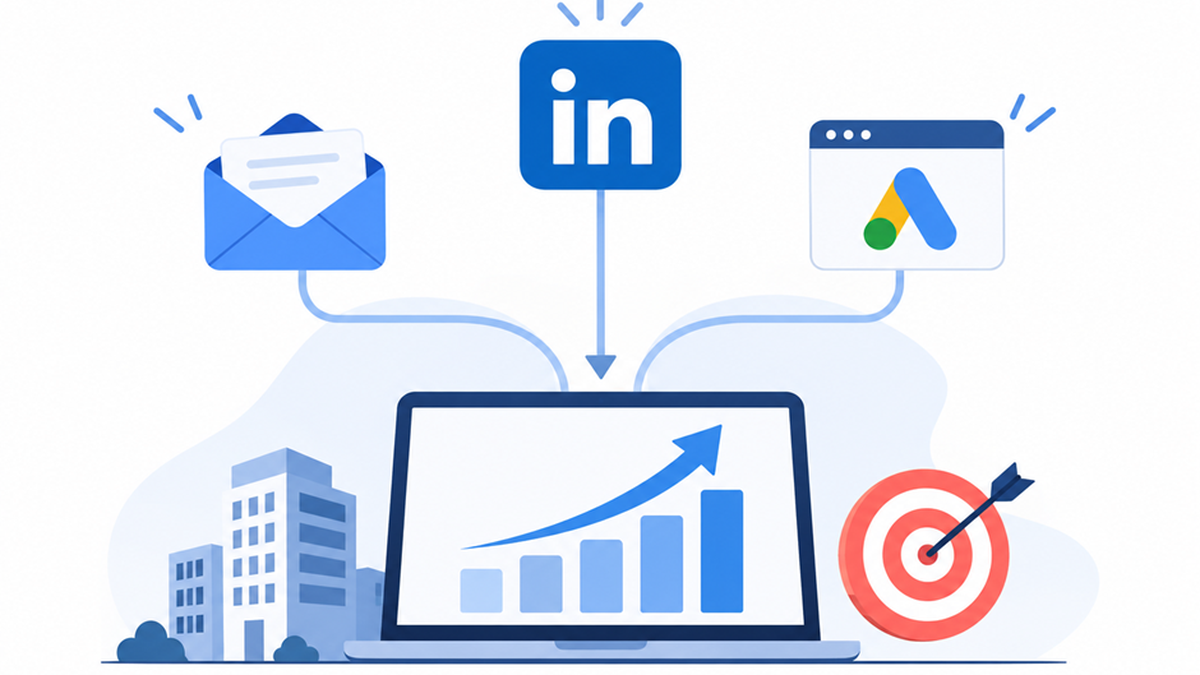
A multi-channel B2B Engine helps businesses connect with potential buyers through cold email, LinkedIn, and paid advertising. Each channel plays a different role in reaching decision-makers, building trust, and generating qualified sales opportunities. When these channels work together, businesses can create stronger engagement, improve lead generation, and build a more consistent sales pipeline
The Paradox at the Heart of Multi-Channel B2B Strategy
A multi-channel B2B strategy helps businesses connect with potential buyers through cold email, LinkedIn, and paid advertising. By combining these channels, businesses can reach decision-makers, build brand awareness, improve engagement, and generate qualified sales opportunities.
Picture a composite familiar to any demand-generation leader at a Series C security vendor. Cold email books meetings. LinkedIn followers climb. Paid ads deliver clicks at a defensible cost. Every channel owner reports green, yet pipeline stalls and the CFO sees none of it.
The cause is structural. Gartner research finds that buyers spend only 17% of their purchase journey meeting suppliers. With three vendors in contention, each gets roughly 5 to 6%. Buying groups typically hold six to ten decision-makers. Most of your prospect’s opinion forms while you are absent.
A multi-channel B2B strategy is the answer to that absence. It is not a media mix, which is merely a list of budget lines. It is an engine: a system in which each channel raises the conversion rate of the others. Consider the arithmetic of attention. The Ehrenberg-Bass Institute, whose work LinkedIn’s B2B Institute popularized, estimates that only about 5% of a B2B market is in the buying window at any moment. Cold email harvests that 5%. Paid media and LinkedIn build memory among the other 95%, so that when those buyers enter the market, you are already familiar. Familiarity compounds into trust, and trust compresses the sales cycle.
The Operating Model: Three Layers of a Multi-Channel B2B Engine
Layer one: one list, one truth
Most multi-channel B2B programs fail before launch. Email targets one list, ads target another, and LinkedIn outreach follows a rep’s intuition. Build a single tier-one list of 300 to 500 accounts, map the buying committee inside each, and feed that list to every channel. This is account-based marketing applied to outbound lead generation.
Layer two: one job per channel
- Paid advertising is air cover. Account-targeted LinkedIn and display ads establish category presence with named accounts. Judge them on assist value, not direct leads.
- LinkedIn is credibility. Executive profiles, founder commentary, and customer proof turn a cold name into a known one.
- Cold email is conversion. It is the only channel of the three that asks directly for a meeting, and it performs best when the recipient arrives pre-warmed.
Layer three: sequence, don’t blast
A twelve-day cadence illustrates the principle. Ads serve to target accounts from days one to three. A personalized connection request follows on day four. The first email, leading with insight rather than a pitch, lands on day six. A LinkedIn message follows on day nine, and a final email with a concrete offer closes on day twelve. Each touch references the last, and each channel hands off to the next.
Guardrails. Enterprise buyers punish sloppiness, so a multi-channel B2B program must protect its own reputation:
- Authenticate sending domains (SPF, DKIM, DMARC) and cap daily volume.
- Suppress open opportunities and existing customers from outbound and prospecting ads.
- Honor CAN-SPAM, CASL, and GDPR. Under GDPR, legitimate-interest outreach requires documentation and an easy opt-out.
- Avoid LinkedIn automation tools, which breach the platform’s terms and risk account restriction.
- Align sales and marketing on one definition of a qualified meeting before launch, or the engine will stall at handoff.
Metric-Driven Impact: How to Measure a Multi-Channel B2B Engine
Retire vanity metrics such as impressions, open rates, and connection counts. Judge the multi-channel B2B engine at the system level, using four measures:
- Sales-qualified meetings per 100 target accounts. This is the cleanest output measure, indifferent to which channel claims credit.
- Blended CAC. The goal is not the cheapest channel but the mix that minimizes acquisition cost per closed deal. Spending more on ads can lower total CAC if it lifts email reply rates.
- Pipeline velocity. Multiply opportunities by deal size and win rate, then divide by sales cycle length. Multi-threaded engagement across the buying committee improves several of those variables at once.
- LTV-to-CAC ratio. Track it by cohort, and treat 3:1 as a common floor for healthy economics.
Then abandon last-click attribution. It credits the email and ignores the ad that made the email work. Use multi-touch or account-level engagement scoring, and report influenced pipeline. A framework blind to assist value will defund its best-performing channel. For proof rather than assumption, run a holdout test: withhold ads from a matched subset of accounts and compare email reply rates. That single experiment turns the multi-channel B2B case from opinion into evidence.
The Strategic Takeaway: Build the Engine, Not the Channels
Return to our composite vendor. The fix required no new tool and no larger budget. The team merged three lists into one, gave each channel a single job, and sequenced touches across two weeks. They stopped asking which channel works and started asking whether the system works.
Three principles are worth carrying out of this room:
- Unify the data. A multi-channel B2B engine is only as strong as its shared account list.
- Assign the roles. Each channel does one job brilliantly.
- Measure the system. Performance is a pipeline conversation, not a click-through conversation.
Competitors can copy your ad creative, your email copy, even your LinkedIn voice. They cannot quickly copy orchestration. So on Monday morning, gather your three channel owners. Put one account list on the screen. Ask each to name their channel’s single job. If they cannot, you do not have a multi-channel B2B engine. You have three budgets.
Build the engine.
Frequently Asked Questions: Multi-Channel B2B with Cold Email, LinkedIn, and Paid Ads
Why combine cold email, LinkedIn, and paid advertising instead of mastering one?
Each does a different job. Paid ads build category presence, LinkedIn builds credibility, and cold email converts attention into meetings. Alone, each hits a ceiling. Together, each lifts the others’ response rates.
In what order should the three channels run in a multi-channel B2B campaign?
Start ads first, follow with a LinkedIn connection request, then send the first email. By the time the email lands, the prospect recognizes your name.
How do we keep cold email and LinkedIn outreach compliant?
Follow CAN-SPAM, CASL, and GDPR rules, include clear opt-outs, and document your lawful basis. Never use LinkedIn automation tools that violate platform terms.
How do we prove a multi-channel B2B engine is working?
Track sales-qualified meetings per 100 target accounts, blended CAC, pipeline velocity, and LTV-to-CAC. Validate with a holdout test rather than last-click attribution.
How long until we see results?
Expect leading indicators, such as reply rates, LinkedIn acceptance, and account engagement, within the first quarter. Pipeline impact typically takes at least one full sales cycle.