
How to Build a Predictable B2B Sales Pipeline
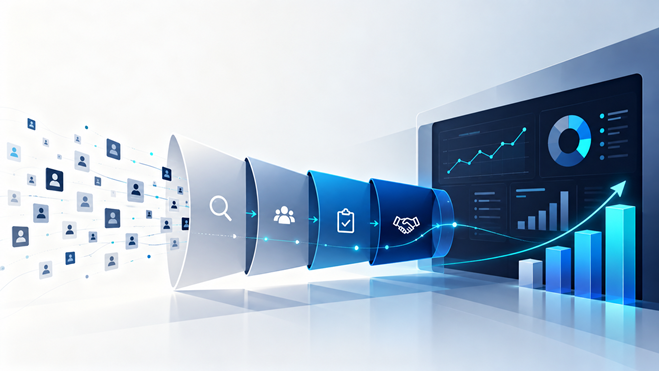
Building a strong B2B sales pipeline is essential for technology companies that want to generate qualified opportunities, improve sales performance, and forecast revenue more effectively.
Yet, when the CEO asks a straightforward question,“How much new revenue can we realistically expect next quarter?”,the answer is often a guess.
This is a common challenge for technology companies, IT services providers, B2B SaaS businesses, AI startups, and cybersecurity firms. Activity is visible, but future revenue remains uncertain.
The problem is not always a shortage of leads. It may be an unclear ideal customer profile (ICP), inconsistent prospecting, weak qualification, poor follow-up, or a lack of reliable conversion data.
A predictable B2B sales pipeline is not created by generating more leads. It is created by building a repeatable system that turns the right target accounts into qualified opportunities and measurable revenue.
For founders, this means greater visibility into growth. For sales leaders, it means better forecasting and resource allocation. For sales professionals, it means knowing which activities deserve their time.
In this guide, we explain how to build a predictable B2B sales pipeline, the metrics that matter, the mistakes that undermine performance, and a practical framework technology companies can implement.
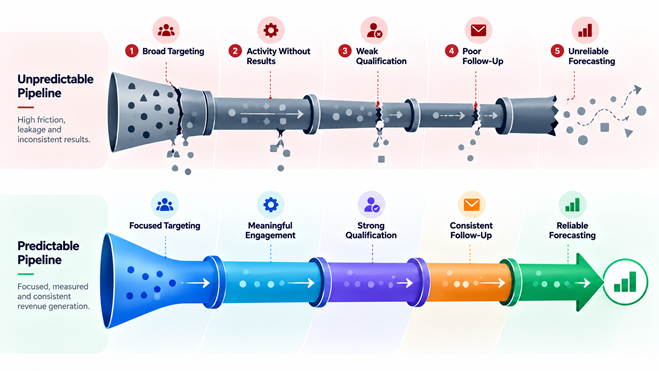
A structured B2B sales pipeline helps businesses connect account research, personalized outreach, lead qualification, and revenue forecasting.
What Is a B2B Sales Pipeline?
A B2B sales pipeline is the sequence of stages through which potential business customers progress, from initial prospecting and qualification to proposal, negotiation, and closed-won revenue.
A predictable pipeline goes a step further. It gives leadership a defensible estimate of future sales based on historical conversion rates, current opportunities, deal values, sales-cycle duration, and the activities required to create new opportunities.
A healthy pipeline helps answer five questions:
- Are we targeting companies that genuinely need our solution?
- Are we reaching the right decision-makers?
- Are enough qualified meetings becoming real sales opportunities?
- Are opportunities progressing through the sales process at an acceptable rate?
- Is our pipeline sufficient to support our revenue target?
HubSpot’s sales pipeline guidance emphasizes clearly defined stages, opportunity ownership, deal values, and next steps for effective pipeline management. (1, 2)
Consider a cybersecurity company selling enterprise security services. It might generate 500 contacts in a month. But if those contacts do not match its ICP, lack purchasing influence, or have no relevant business need, the company may still end the month without a meaningful opportunity.
The better question is not, “How many leads did we generate?” It is, “How many qualified opportunities did we create, and what does our conversion data tell us about future revenue?”
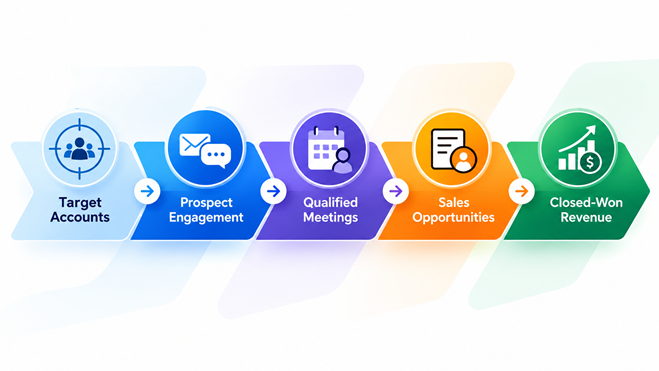
Why B2B Sales Pipeline Performance Becomes Unpredictable
1. Targeting too broad an audience
A technology company may target every business that could theoretically use its product. This expands the prospect database but often reduces relevance.
An AI company selling workflow automation to enterprise finance teams, for example, should not automatically treat every company using AI as a suitable prospect. Its strongest prospects may have specific operational bottlenecks, sufficient transaction volumes, a suitable technology environment, and an identifiable business owner.
2. Measuring activity instead of outcomes
Emails sent, contacts added, and LinkedIn connections accepted are activity metrics. They show that work is happening, not necessarily that pipeline is being created.
If outreach volume increases but qualified meetings remain flat, the company must investigate its targeting, messaging, deliverability, or offer.
3. Treating every lead as an opportunity
A prospect who downloads a report is not necessarily ready to buy. Neither is someone who accepts a LinkedIn invitation. Sales opportunities should meet explicit qualification criteria rather than enter the forecast simply because a prospect has responded.
4. Inconsistent follow-up
A prospect might express interest but receive no timely response. Another might receive repeated messages without meaningful context. Both situations weaken the sales process. Every active opportunity needs an owner, a documented next action, and an appropriate follow-up date.
5. Forecasting without historical evidence
A company may assume that three times its revenue target in pipeline will always be sufficient. But coverage requirements depend on win rates, average deal size, sales-cycle length, and opportunity quality. A pipeline forecast becomes more reliable when assumptions are grounded in the company’s own data.
The Filesie B2B Pipeline Generation Framework
This B2B sales pipeline framework connects prospect research, targeted engagement, lead qualification, and revenue optimization into one repeatable process.
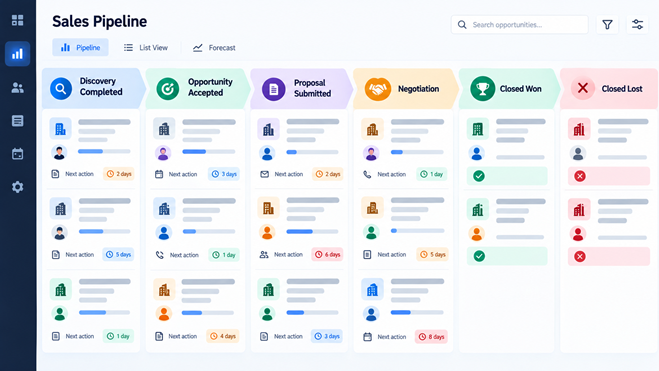
A well-managed B2B sales pipeline dashboard helps sales leaders monitor conversion rates, identify bottlenecks, and make informed forecasting decisions.
1. DEFINE | Establish the ICP, commercial objectives, target segments, and qualification criteria. |
2. IDENTIFY | Build accurate account lists, map decision-makers, and prioritize relevant buying signals. |
3. ENGAGE | Use personalized cold email and relevant LinkedIn prospecting to start business conversations. |
4. QUALIFY | Convert meaningful engagement into qualified meetings and documented sales opportunities. |
5. OPTIMIZE | Measure conversion, identify bottlenecks, refine campaigns, and improve forecasts. |
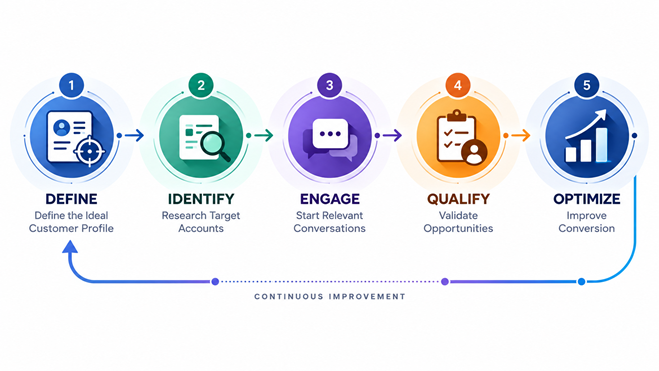
The framework connects prospect research and outbound execution with the commercial outcomes that matter to leadership. Each stage produces measurable inputs for the next, creating a feedback loop instead of a disconnected collection of sales activities.
This B2B sales pipeline framework connects prospect research, targeted engagement, lead qualification, and revenue optimization into one repeatable process.
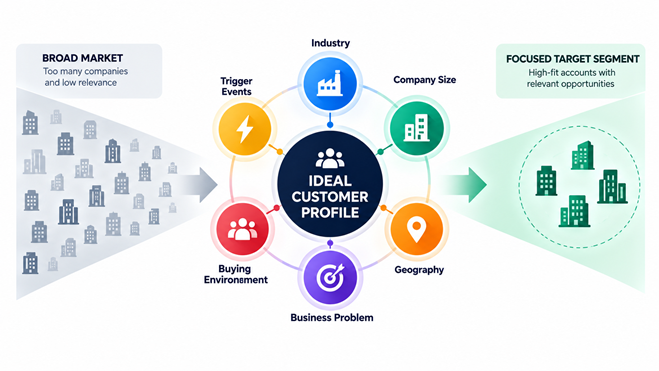
Step 1: Define Your Ideal Customer Profile for B2B Sales
The foundation of predictable B2B pipeline generation is a well-defined ICP.
Your ICP describes the type of organization most likely to benefit from your solution and become a commercially valuable customer. It should be specific enough to guide account selection and qualification.
For technology companies, define the ICP using factors such as:
- Industry: SaaS, cybersecurity, IT services, financial technology, or another relevant sector.
- Company size: Employee count, revenue range, or operational scale.
- Geography: Markets where your solution, pricing, and delivery model are competitive.
- Business problem: The operational, technical, or commercial challenge you solve.
- Buying environment: Budget availability, purchasing complexity, and decision-making structure.
- Trigger events: Expansion, funding, product launches, leadership changes, or other relevant developments.
For example, an IT services firm seeking US clients might initially target mid-market software companies that are expanding engineering teams and need specialized development support. This is more actionable than targeting “all US technology companies.”
Review existing customers and identify which profiles have delivered the strongest combination of revenue, retention, profitability, and ease of delivery. Use these patterns to develop your initial ICP, then refine it using campaign and sales outcomes.
Practical rule: Start with a narrow, testable segment. Expand only when you have evidence that the segment is working or that another segment deserves priority.
Step 2: Build Account Intelligence for B2B Prospecting
Once the ICP is clear, build a target account list. The objective is not to collect the largest possible database. It is to identify organizations where your offer is relevant and where you can reach the people involved in a purchasing decision.
Account intelligence should capture:
- Company name, website, industry, and geography.
- Company size and relevant business characteristics.
- Decision-makers and other stakeholders.
- Their role in the buying process.
- A relevant business problem or potential trigger.
- A reason your solution may be valuable to that company.
LinkedIn can help identify professional roles, organizational structures, and relevant company developments. Public company websites, product announcements, hiring pages, and other reliable sources can provide additional context.
For example, a cybersecurity provider may prioritize a company that is expanding its cloud infrastructure and recruiting security specialists. Those signals do not prove that the company intends to purchase the provider’s services, but they can provide a credible reason to investigate further.
Score accounts using consistent criteria, such as ICP fit, business relevance, buying signals, and accessibility of the buying committee.
Keep the distinction clear: a buying signal is a reason to investigate an account, not proof that a purchase is imminent.
Step 3: Create a Personalized Outreach System
With target accounts identified, the next step is to initiate relevant conversations. Cold email and LinkedIn prospecting can complement each other when each interaction has a clear purpose. The goal is not to contact a prospect on every available channel indiscriminately. It is to communicate a relevant business hypothesis in a way that respects the prospect’s time and preferences.
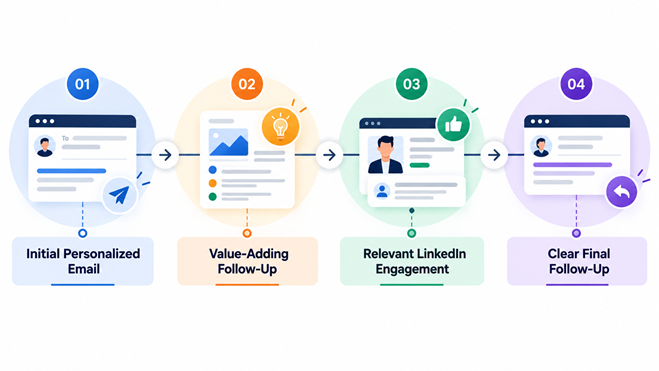
A practical outbound sequence should include:
- An initial message linked to a relevant business problem.
- A follow-up that adds useful context or a different perspective.
- A credible example, insight, or explanation of potential value.
- A final follow-up that gives the prospect a straightforward way to respond or decline further contact.
Personalization should go beyond inserting a first name or company name. It should explain why the message is relevant to that particular account or role.
Generic example: “We provide AI solutions to businesses. Would you like to schedule a demo?”
More relevant example: “We work with technology teams looking to reduce manual work in complex workflows. Is improving workflow efficiency a priority for your team this quarter?”
The second message begins with a potential business need rather than an unsolicited product presentation. It should still be tailored to a genuine, researched reason for contacting the prospect.
Multichannel engagement is also worth considering. Dreamdata’s 2024 B2B go-to-market benchmark reported an average of 62 interactions across at least three channels before a B2B deal closed in its analysed journeys. This is a benchmark from a particular dataset, not a universal outreach requirement for every company. (5)
For businesses selling complex technology solutions, the broader lesson is that buyers may need multiple relevant interactions before making a decision. Build coordinated outreach and nurturing rather than relying on one email to generate every opportunity.
Use appropriate consent, lawful-basis, identification, and opt-out practices for each market. A technically deliverable email is not automatically a compliant or commercially appropriate email.
Step 4: Qualify Prospects Before Calling Them Opportunities
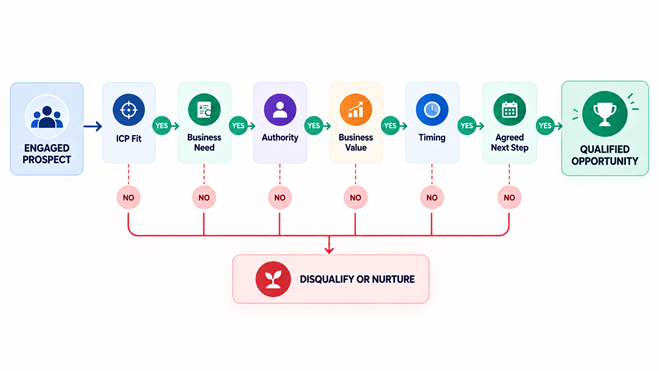
A predictable pipeline requires a clear distinction between a contact, an engaged prospect, a qualified meeting, and a genuine sales opportunity. Without this distinction, sales teams can report impressive activity while maintaining a weak revenue forecast.
Use a consistent qualification process that establishes:
- Fit: Does the company match the ICP?
- Need: Is there a relevant business problem?
- Authority: Are the right decision-makers or influencers involved?
- Value: Is there a credible business case for solving the problem?
- Timing: Is there a reason to evaluate a solution now or in a defined future period?
- Next step: Has the prospect agreed to a meaningful action?
Frameworks such as BANT (Budget, Authority, Need, Timeline) and MEDDIC (Metrics, Economic Buyer, Decision Criteria, Decision Process, Identify Pain, Champion) can help sales teams structure qualification. The appropriate framework depends on deal complexity and the maturity of the sales organization. (1, 4)
For a smaller IT services engagement, a concise qualification checklist may be sufficient. For a six-figure enterprise cybersecurity contract, the team may need to understand the economic buyer, technical evaluation process, procurement requirements, internal champion, and measurable business outcomes.
The important principle is to define qualification before launching campaigns.
For example, if Filesie is helping a client generate meetings, a meeting should not automatically count as a qualified sales opportunity simply because someone attended. The meeting should satisfy agreed criteria, and the client’s sales team should record whether a genuine opportunity emerged.
This creates a shared definition of success between marketing, sales development, and account executives.
Step 5: Design Pipeline Stages Around Observable Buyer Progress
Every business should define its own sales stages, but the stages must represent verifiable progress. A practical B2B sales pipeline for a technology company might look like this:
Clearly defined B2B sales pipeline stages help sales teams track buyer progress and identify opportunities that need attention.
Target account identified | Account matches the ICP and has been researched |
Prospect engaged | Relevant two-way interaction or meaningful buying engagement |
Meeting qualified | Meeting meets the agreed qualification criteria |
Discovery completed | Business need, impact, and relevant stakeholders documented |
Opportunity accepted | Sales owner confirms a genuine opportunity exists |
Proposal submitted | Scope, value, and commercial terms presented |
Negotiation | Commercial, technical, or contractual issues being resolved |
Closed won/lost | Outcome and reason documented |
The distinction between activity and progress is critical. Sending a proposal is an activity; having a proposal accepted for evaluation is evidence of buyer engagement. Likewise, scheduling a meeting is not equivalent to completing a qualified discovery conversation.
HubSpot’s sales pipeline guidance emphasizes defining stages and using explicit criteria to determine when opportunities advance. (2, 3)
For each stage, document the entry criteria, exit criteria, responsible owner, expected next action, and maximum acceptable period without progress. This makes it easier to identify stalled deals and distinguish a genuinely active opportunity from an outdated CRM record.
Step 6: Calculate Pipeline Coverage and Work Backward From Revenue
Sales leaders need to understand how much pipeline is required to meet their targets.
Pipeline Coverage = Qualified Pipeline Value ÷ Revenue Target
Suppose an IT services company has a quarterly new-business revenue target of $150,000. Its qualified pipeline contains $450,000 in opportunities expected to close during the relevant period.
$450,000 ÷ $150,000 = 3.0×
The company has 3× pipeline coverage. However, this does not mean the company will necessarily achieve its target. Some deals will be lost, some will be delayed, and others may close for a smaller amount than initially expected.
A coverage ratio must be interpreted using historical win rates, deal timing, and opportunity quality. Coverage requirements vary with market conditions, competitive position, and sales strategy rather than following one universal ratio. (1)
Work backward from the required number of opportunities
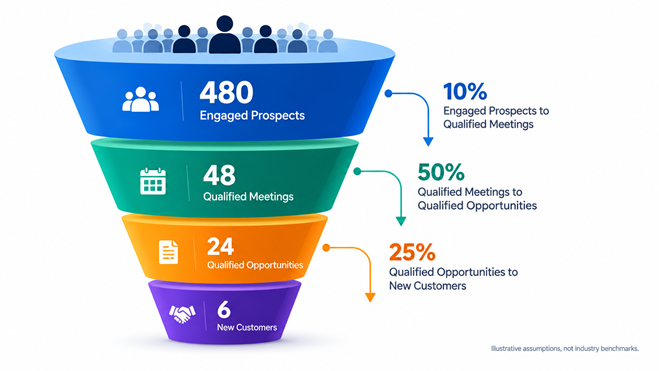
Consider the following illustrative example, using assumed conversion rates rather than an industry benchmark. A B2B SaaS company wants to close six new customers in a quarter.
- Qualified opportunity-to-win rate: 25%.
- Qualified meeting-to-opportunity rate: 50%.
- Initial prospect engagement-to-qualified-meeting rate: 10%.
New customers | Revenue objective | 6 |
Qualified opportunities | 6 ÷ 25% | 24 |
Qualified meetings | 24 ÷ 50% | 48 |
Engaged prospects | 48 ÷ 10% | 480 |
Under these assumptions, the company needs 24 qualified opportunities, generated from 48 qualified meetings, which require 480 engaged prospects.
These are planning estimates, not guaranteed outcomes. Actual conversion rates should be calculated from the company’s own historical data and segmented by channel, market, and ICP.
Important distinction: Pipeline value, weighted pipeline value, and closed revenue are not interchangeable. A forecast should account for opportunity stage, historical conversion, deal timing, and probability of closing.
Step 7: Track B2B Sales Pipeline Metrics
A useful sales dashboard should show whether the system is generating enough opportunities, converting them efficiently, and moving them toward revenue.
B2B sales pipeline metrics help identify conversion gaps, monitor opportunity quality, and improve sales forecasting.
ICP-fit rate | Whether prospect selection matches the target market |
Positive reply rate | Whether outreach is generating relevant interest |
Qualified meeting rate | Whether engagement becomes meaningful sales conversations |
Meeting-to-opportunity conversion | Whether discovery produces genuine opportunities |
Opportunity win rate | How effectively the team converts opportunities into customers |
Average deal value | The typical commercial value of closed business |
Sales-cycle length | How long opportunities take to close |
Pipeline coverage | Whether sufficient qualified value exists against the target |
Stage ageing | Where opportunities are becoming stalled |
Forecast accuracy | How closely forecast revenue matches actual results |
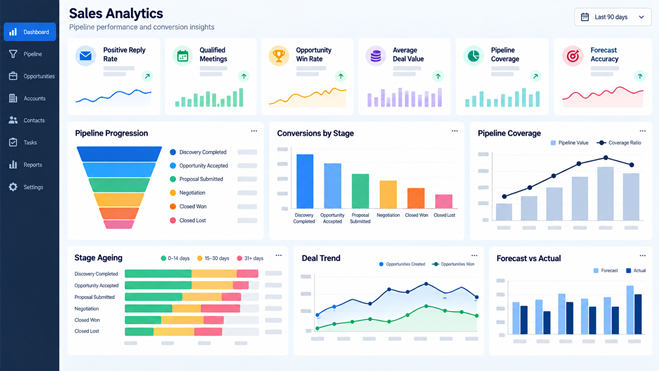
Metrics should be reviewed together. A high positive reply rate alongside a low qualified-meeting rate may indicate that the messaging attracts curiosity without sufficient commercial relevance.
A strong meeting rate but poor opportunity conversion may suggest weak qualification, an unclear offer, or a mismatch between the people attending meetings and the actual buying committee.
A healthy opportunity-to-win rate combined with insufficient pipeline volume may indicate that the sales team can close effectively but needs more qualified opportunities.
These distinctions matter because each problem requires a different intervention.
Step 8: Establish a Weekly Review and Optimization Cycle
A predictable pipeline is maintained through consistent review, not created once and left untouched.
- Daily: Review prospect replies, meeting preparation, urgent follow-ups, and overdue actions.
- Weekly: Examine pipeline creation, qualification, stage conversion, stalled opportunities, and next steps.
- Monthly: Compare segment and channel performance, review win-loss reasons, and update targeting or messaging.
- Quarterly: Reassess the ICP, revenue assumptions, sales capacity, market priorities, and resource allocation.
Each review should answer three questions:
- What changed in the pipeline?
- Why did it change?
- What action will improve the next period’s results?
If one ICP segment consistently produces qualified meetings but rarely converts into opportunities, investigate the offer and qualification criteria before increasing outreach volume.
If one market generates fewer replies but substantially larger deals, compare expected revenue, sales-cycle duration, and acquisition costs before deciding which market deserves more resources.
The purpose of analytics is not to produce more dashboards. It is to make better commercial decisions.
90-Day B2B Sales Pipeline Implementation Plan
For technology companies that need a more structured approach to business development, a 90-day implementation plan can provide a practical starting point. This 90-day B2B sales pipeline plan provides a structured approach to improving targeting, outreach, qualification, and sales performance.
This 90-day B2B sales pipeline plan provides a structured approach to improving targeting, outreach, qualification, and sales performance.
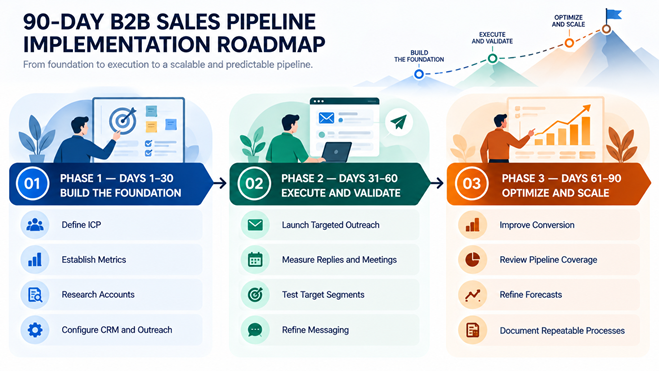
DAYS 1–30 | BUILD THE FOUNDATION
- Define the ICP and prioritize target segments.
- Establish baseline conversion metrics and revenue targets.
- Research target accounts and decision-makers.
- Configure outreach infrastructure and CRM tracking.
- Develop and test initial messaging.
DAYS 31–60 | EXECUTE AND VALIDATE
- Launch targeted email and LinkedIn prospecting.
- Monitor deliverability, positive replies, and qualified meetings.
- Evaluate which ICP segments respond meaningfully.
- Refine messaging and follow-up sequences.
- Document objections and qualification outcomes.
DAYS 61–90 | OPTIMIZE AND SCALE
- Prioritize segments that generate qualified opportunities.
- Improve meeting-to-opportunity conversion.
- Review pipeline coverage and forecast assumptions.
- Eliminate ineffective targeting and messaging.
- Establish a repeatable process for the next quarter.
The expected outcome is a better-defined sales process, clearer performance data, and an evidence-based understanding of which activities can support future pipeline growth. Closed revenue will depend on the starting position, sales cycle, offer, market, and execution.
Common Mistakes to Avoid
Even a well-designed pipeline framework can fail if the operating discipline is weak. Avoid these six mistakes:
- Buying or building enormous prospect lists without validating ICP fit. Database size does not establish commercial relevance.
- Treating email opens or LinkedIn connections as buying intent. Measure meaningful engagement and downstream conversion instead.
- Changing too many campaign variables at once. Test segments, messaging, and offers systematically so the results remain interpretable.
- Moving opportunities forward without evidence. Every pipeline stage should have explicit entry and exit criteria.
- Ignoring negative outcomes. Lost deals, disqualified prospects, and non-responses contain information that should influence the next campaign.
- Scaling before validating the economics. Confirm that cost, conversion rate, deal value, and sales-cycle duration support the intended growth target.
The most effective pipeline is not necessarily the largest. It is the one whose performance the business understands well enough to improve.
How Filesie Helps Technology Companies Build Their Pipeline
Filesie helps B2B technology companies establish a structured outbound sales development process, connecting account research and targeted engagement with qualified sales conversations.
Our approach brings together five capabilities:
- ICP research: Identify the segments most relevant to your offer and commercial objectives.
- Account intelligence: Research target companies, relevant stakeholders, and potential business triggers.
- Personalized cold email outreach: Develop targeted campaigns that communicate a credible reason to engage.
- LinkedIn prospecting: Support account engagement and relationship development alongside email outreach.
- Qualified sales meetings: Focus on opportunities that meet agreed qualification criteria rather than reporting activity alone.
This approach is relevant to B2B SaaS businesses, cybersecurity providers, AI companies, IT services firms, and technology consultancies seeking customers in the United States, United Kingdom, Canada, Australia, the UAE, and South Africa.
Filesie’s 90-Day Pipeline Program is designed around a structured period of ICP definition, prospect research, outbound execution, and performance optimization.
The objective is to establish a repeatable process that supports sales development without requiring every business to build a large in-house SDR function from the outset.
The right approach depends on your target market, average contract value, sales cycle, internal sales capacity, and current pipeline performance. Those factors should be assessed before committing to a particular volume of meetings or revenue target.
WANT TO BUILD A MORE PREDICTABLE B2B SALES PIPELINE?
Explore Filesie’s 90-Day Pipeline Program to discuss how targeted account intelligence, personalized outreach, and qualified sales meetings can support your growth strategy.
Learn more: https://filesie.com/
Frequently Asked Questions
1. How do you build a predictable B2B sales pipeline?
Start by defining your ideal customer profile, researching target accounts, and identifying relevant decision-makers. Build a structured outreach process, establish clear qualification criteria, define observable pipeline stages, and track conversion rates through to closed revenue. Review the data regularly to improve targeting and forecasting.
2. What is the ideal pipeline coverage ratio for a B2B technology company?
There is no universal ideal. A company with a high win rate may need less pipeline coverage than a business entering a new market or selling a complex enterprise solution. Calculate coverage using qualified pipeline value divided by the revenue target, then compare it against historical win rates, sales-cycle timing, and forecast accuracy.
3. How long does it take to build a B2B sales pipeline?
The time required depends on the market, offer, deal size, sales cycle, and existing demand. Initial outreach responses and meetings may emerge earlier than qualified opportunities or closed revenue. A 90-day programme can establish a structured process and generate useful performance data, but it should not be treated as a guaranteed revenue timeline.
4. What metrics matter most in B2B pipeline generation?
Prioritize ICP-fit rate, positive reply rate, qualified meetings, meeting-to-opportunity conversion, opportunity win rate, average deal value, sales-cycle duration, pipeline coverage, and forecast accuracy. These metrics show both the quantity and the commercial quality of pipeline creation.
5. Is cold email enough to generate a predictable pipeline?
Cold email can be an effective acquisition channel, but relying exclusively on it may limit reach. Targeted LinkedIn engagement, referrals, relevant content, and other appropriate channels can support the buying journey. The right mix depends on the audience, product complexity, and market.
6. Should a company outsource B2B sales development?
Outsourcing may be appropriate when a business needs prospect research, outbound campaign execution, or sales development capacity without immediately hiring a full internal team. Before choosing a partner, define the ICP, agree on qualification criteria, establish reporting requirements, and clarify how qualified meetings will be measured.