
Founder Sales Bottleneck: Why Founders Become the Constraint on Growth
Introduction
The founder sales bottleneck often appears when a B2B company is winning customers but struggling to grow beyond the founder’s personal capacity. The founder knows the product, understands customer pain, builds trust quickly and can navigate difficult commercial conversations. Those strengths help a business win its first customers-but they can become a constraint when every important deal still requires the founder.
The answer is not to remove founders from sales overnight. Founder-led selling is often essential while a company is validating its offer and learning why customers buy. The challenge is to turn founder knowledge into a sales process other people can execute, improve and own.

For additional perspective, see Joe Dalton’s discussion of the founder sales bottleneck and HubSpot’s guide to scaling founder-led sales.
Why Founder-Led Sales Becomes a Bottleneck
In the early stages, the founder is often the entire commercial function: prospecting, discovery, pitching, pricing, negotiation and closing. Decisions are fast because knowledge and authority sit in one person. As the company grows, however, more prospects, team members and opportunities compete for that same attention.
A founder sales bottleneck develops when the team cannot move a deal forward without the founder’s presence, approval or intervention. Typical symptoms include:
- Salespeople wait for the founder to join important calls or approve proposals.
- Different reps qualify prospects and explain value in inconsistent ways.
- CRM stages exist, but there are no shared standards for advancing opportunities.
- Follow-ups, pricing decisions or customer answers are delayed while the founder is unavailable.
- The founder repeatedly rescues deals instead of coaching the team to handle them.
The issue is not founder involvement itself. Strategic customers, complex negotiations and executive relationships may benefit from the founder. The problem is dependency: the business has no reliable alternative when the founder is not available.
1. Separate Founder Involvement from Founder Dependency
Founder involvement is a deliberate choice; founder dependency is an operating requirement. A founder should remain involved where their credibility, product insight or executive relationship materially improves the outcome. Routine discovery, qualification, follow-up and standard proposals should not automatically escalate to the CEO. For a related discussion of transitioning founder-led sales as a company grows, see HubSpot’s founder-led sales scaling guide.
Map the sales activities that require founder participation. For each one, ask: Does this genuinely require founder authority or expertise, or does the team lack information, training, confidence or decision rights? This distinction helps identify what should stay founder-led and what can be delegated.
2. Document the Sales Process-Not Just the CRM Stages
A pipeline labelled Prospect → Meeting → Proposal → Negotiation → Closed Won is not a complete sales process. Reps also need to know what good execution looks like inside each stage.
Document practical stage standards:
- Qualification: what account fit, business need, urgency and stakeholder access must be established?
- Discovery: what questions reveal business impact, desired outcome and decision process?
- Proposal: what must be confirmed before scope, pricing and recommendations are presented?
- Follow-up: who owns the next action, by when, and what should happen if the buyer goes quiet?
- Escalation: which deal risks genuinely require founder involvement?
Use real won and lost deals to build the playbook. HubSpot’s guidance on building a scalable sales process for early-stage businesses supports learning from actual sales activity and codifying what proves repeatable. Avoid documenting an idealised process that has not worked in the market.
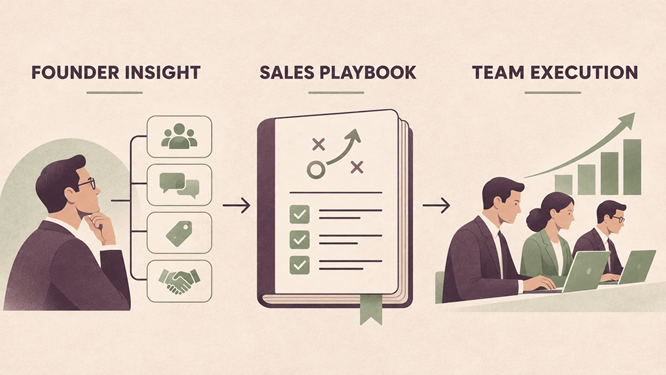
3. Transfer Founder Knowledge Through Coaching and Deal Reviews
A sales playbook cannot capture every nuance of a founder’s judgement. Transfer tacit knowledge through structured practice: call shadowing, reverse shadowing, role-play, recorded-call reviews where lawful, and coaching after live opportunities.
Start with a gradual handoff. The founder leads calls while the rep observes; next, the rep leads while the founder supports; finally, the rep owns the conversation and the founder reviews outcomes. Use a consistent rubric covering discovery, problem clarity, value articulation, stakeholder mapping, objections and next steps.
The goal is not to make every salesperson sound like the founder. It is to establish a shared commercial standard while allowing individual selling styles.

4. Delegate Decisions with Clear Guardrails
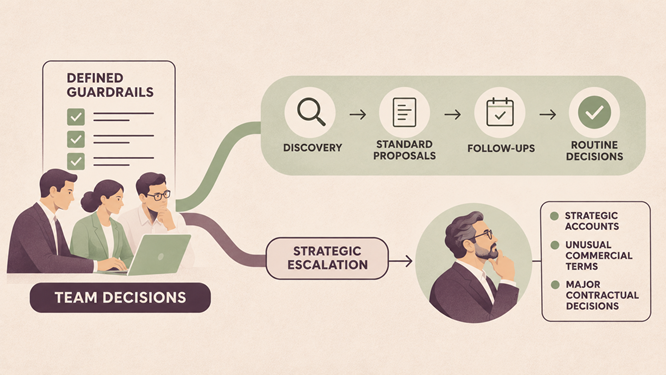
Hiring a salesperson without giving them decision authority simply creates another person who needs founder approval. Define what reps can decide independently and what requires escalation.
For example, the team may be authorised to run standard discovery, send approved proposal formats, offer pricing within a defined range and schedule follow-ups. Founder approval may remain necessary for non-standard pricing, strategic partnerships, unusual contractual risk or major enterprise commitments.
Make the guardrails visible: approval thresholds, discount limits, deal qualification rules and escalation triggers. Review exceptions regularly and adjust the boundaries as the team demonstrates sound judgement.
5. Measure Sales System Performance, Not Founder Heroics
If the founder is the only person closing deals, revenue may look healthy while the sales system remains fragile. Track whether opportunities progress when the founder is absent, not simply how many calls the founder attends.
Useful indicators include:
- Founder-involved share of qualified opportunities and closed deals.
- Rep-led discovery-to-opportunity conversion.
- Time waiting for founder approvals or answers.
- Sales-cycle duration and stage ageing.
- Forecast accuracy and win/loss reasons by owner or segment.
- Rep ramp time and proportion of deals handled independently.
Interpret these metrics in context. A founder’s participation in a strategic deal is not automatically a failure. Look for repeated founder intervention in routine opportunities and identify the underlying capability or process gap.
A Practical 30-Day Plan to Reduce Founder Dependency
Period | Action |
Week 1 – Audit | Review recent deals and log founder touchpoints, approvals and rescues. Categorise each as strategic, expertise-driven or routine. |
Week 2 – Standardise | Write qualification criteria, stage exit conditions, discovery questions and follow-up expectations from real deals. |
Week 3 – Transfer | Choose a small group of opportunities for rep-led execution. Shadow, coach and define approval boundaries. |
Week 4 – Review | Compare rep-led and founder-led progress, identify friction, update the playbook and delegate the next set of decisions. |
This is a starting framework, not a promise that founder dependency will disappear in 30 days. The right pace depends on deal complexity, team experience and how much of the sales motion has already been validated.
Conclusion: Build a Sales System That Can Grow Beyond the Founder
Founders should not abandon sales; they should evolve their role as the business matures. Early founder-led selling creates customer insight and commercial momentum. Sustainable growth comes when that insight is documented, taught, delegated and continuously improved.
Reducing the founder sales bottleneck means building a team that can qualify, progress and close appropriate opportunities without waiting for the CEO at every step. Keep the founder close to strategic customers and market learning-but make routine sales execution a capability of the company, not a single individual.
Want to build a more structured B2B outbound sales process? Explore Filesie’s cold email outreach service or contact Filesie to discuss account targeting, sales development and qualified conversations.
Frequently Asked Questions
Is founder-led sales bad for business?
No. Founder-led sales is often valuable during early customer discovery and product-market validation. It becomes a problem when routine sales progress depends on the founder indefinitely.
When should a founder hire a salesperson?
Hire when the company has evidence of a repeatable sales motion, enough demand or pipeline to support the role, and a clear process the new salesperson can learn. Hiring alone does not transfer founder knowledge.
How can a founder delegate sales without losing quality?
Document qualification and stage standards, coach through real calls, establish decision guardrails, and review outcomes. Delegate progressively rather than handing over every deal at once.
Should founders stop joining sales calls?
Not necessarily. Founders should remain involved in strategic or unusually complex opportunities. The objective is to make involvement intentional rather than required for routine deals.