How to Combine B2B Cold Email With a Strong B2B Sales Process
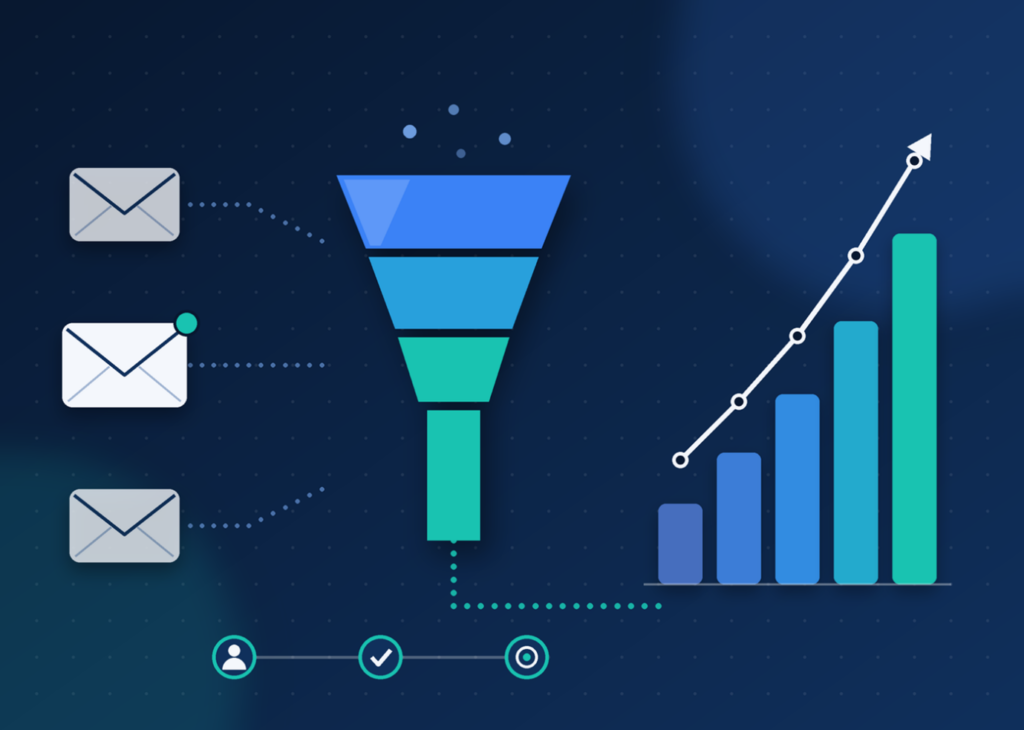
Picture a VP of Sales at a mid-market cybersecurity firm managing a B2B sales process. Her dashboard shows 40,000 emails sent in a quarter, eleven meetings booked, two opportunities created and zero closed deals.
The Paradox: Why the B2B Sales Process Needs Strong Cold Email
B2B cold email is the most honest diagnostic in your go-to-market engine. One send exposes whether your ideal customer profile is sharp, your value proposition is differentiated and your handoffs are clean. Most executives treat cold email outreach as a volume game. The best treat it as a stress test of the entire B2B sales process.
The failure runs in both directions. A cold email strategy that books meetings without qualification simply moves waste downstream: account executives burn hours on bad-fit calls, CAC inflates and pipeline velocity stalls. A disciplined B2B sales process fed by weak cold email starves itself of opportunity. Combining the two isn’t a nice-to-have. It’s the whole game.
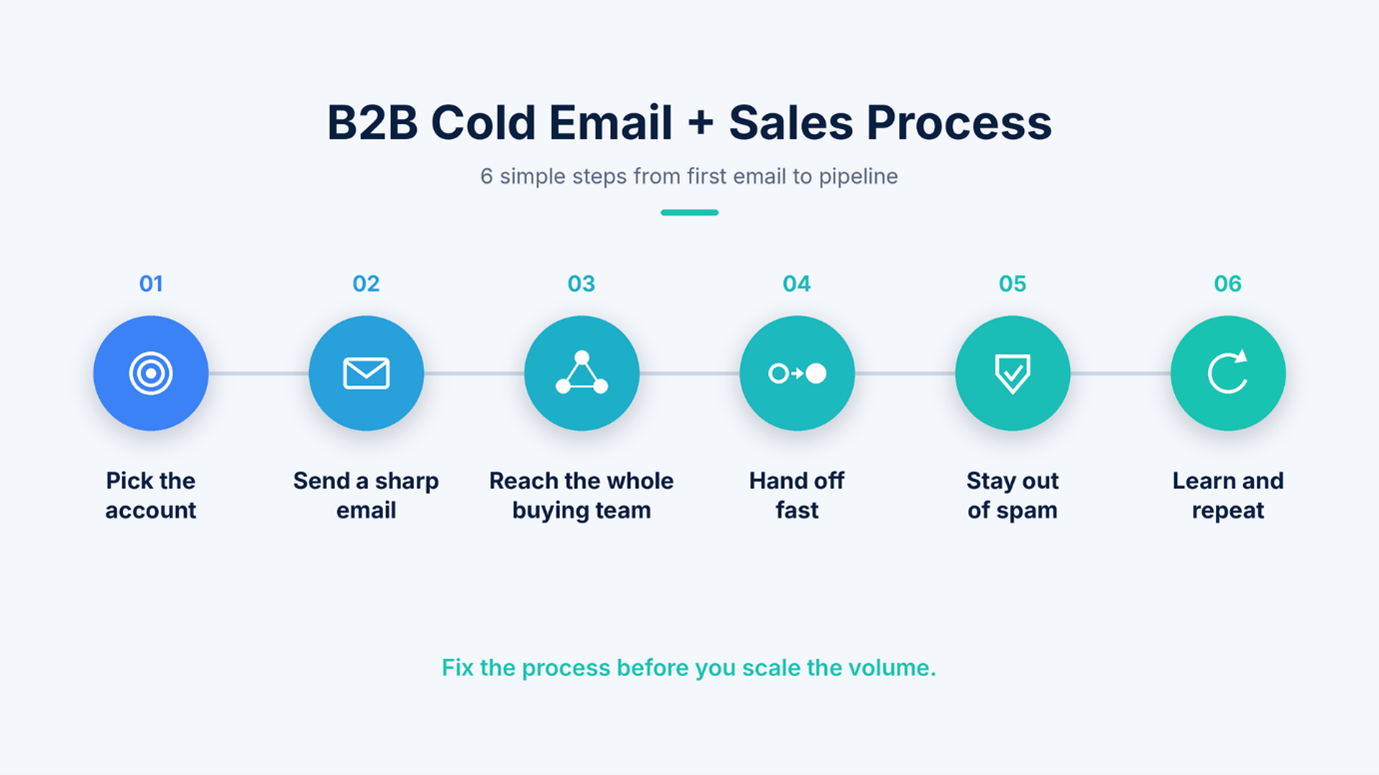
The Framework: Six Steps to Strengthen Your B2B Sales Process
1. Start with the account, not the inbox
Before writing a single B2B cold email, define your ICP with the rigor of an investment thesis. Tier accounts by firmographics, technographics and buying triggers such as funding rounds, leadership changes and cloud migrations. A cold email that references a CIO’s recent platform consolidation earns attention. A generic one earns deletion.
2. Engineer each cold email as a hypothesis
Every message should carry one specific problem, one credible proof point and one low-friction ask. Keep it under 100 words. Test one variable at a time (subject line, offer or call to action) so your cold email strategy compounds learning instead of noise.
3. Multi-thread the buying committee
Enterprise deals are never won by one champion. Run coordinated cold email outreach to the economic buyer, the technical evaluator and the end user, each with role-specific value. This is where B2B cold email stops being a tactic and becomes a sales process.
4. Define the handoff before you scale
Write service-level agreements. A positive reply gets a human response within the hour. A meeting counts only if it meets agreed criteria, whether BANT, MEDDICC or your own framework. Align SDRs and AEs on a shared definition of a sales-qualified meeting before any B2B cold email campaign grows.
5. Protect deliverability like revenue
Infrastructure is strategy. Authenticate domains with SPF, DKIM and DMARC, warm new inboxes, cap daily volume per mailbox and monitor bounce rates. The best cold email copy is worthless in a spam folder, and no B2B sales process survives a damaged sender reputation.
6. Close the loop
Feed what you learn from every cold email reply back into the process. Objections become sales enablement content. Common “not now” responses become nurture sequences. Disqualified accounts sharpen the ICP. This feedback loop is what turns a B2B cold email program into a compounding asset.
The Metrics: Measuring B2B Cold Email Like a CFO
Reply rate alone is a vanity metric. Evaluate B2B cold email across the full funnel:
- Positive reply rate: Interest, not just response. Unsubscribes and “wrong person” replies are noise.
- Sales-qualified meeting rate: The share of cold email meetings that meet your qualification standard.
- Cost per sales-qualified meeting: Data, tooling, headcount and domains, divided by meetings that matter.
- Pipeline velocity: How quickly cold email-sourced opportunities move through each stage compared with inbound and referral.
- CAC and LTV by source: Cohort your cold email customers against other channels. Fast-closing deals with poor retention are expensive in disguise.
Treat B2B cold email as a portfolio, not a campaign. Some segments will deliver high-LTV enterprise accounts at a premium CAC. Others will deliver quick mid-market wins. Your B2B sales process should tell you which to scale and which to starve, and your cold email data should inform that decision every month.
The payoff is predictability. When B2B cold email is wired into a mature sales process, pipeline stops being a quarterly prayer and becomes a controllable input you can model, forecast and invest against.
The Takeaway: Build a Stronger B2B Sales Process
Return to that VP of Sales. She didn’t abandon cold email. She rebuilt the system around it. She narrowed her target list, rewrote every B2B cold email around a single buyer trigger, set a strict qualification gate and gave her SDRs a one-hour response SLA. Her send volume dropped. Her pipeline rose.
A cold email is not a pitch. It is a promise that the next conversation will be worth the buyer’s time. Your B2B sales process is how you keep that promise.
So this quarter, don’t ask, “How many emails can we send?” Ask the harder question: “If every cold email worked, could our B2B sales process handle the result?” If the answer is no, fix the process before you scale the volume.
The inbox is open. The buyer is skeptical. Make the first email count, and make everything after it count more.
Frequently Asked Questions
- Is B2B cold email still effective for enterprise sales?
Yes, when it is targeted and tied to a defined sales process. Generic mass sends perform poorly, but trigger-based cold email outreach aimed at the right buying committee remains one of the most scalable ways to open enterprise conversations. - How does cold email fit into a B2B sales process?
Cold email is the top-of-funnel entry point. It generates qualified conversations that hand off to account executives through clear SLAs and shared qualification criteria, then feeds reply data back into targeting and messaging. - What is a good reply rate for B2B cold email?
Benchmarks vary by industry and audience, but a positive reply rate matters more than total replies. Track positive replies, sales-qualified meetings and cost per meeting rather than chasing a single headline number. - How many follow-ups should a cold email sequence include?
Most effective sequences run three to five touches over two to three weeks, with each follow-up adding new value (a proof point, insight or case study) rather than repeating the original ask. - How do you keep cold email compliant and out of spam?
Authenticate your domains with SPF, DKIM and DMARC, warm new inboxes, limit daily volume per mailbox, honor opt-outs promptly and follow regulations such as CAN-SPAM and GDPR where they apply. Check with your legal team for your specific markets. - How should SDRs and AEs collaborate on cold email outreach?
Agree on one definition of a sales-qualified meeting, set a one-hour response SLA for positive replies and hold a weekly review of objections and win/loss data so messaging improves continuously. - Which metrics prove the ROI of a cold email strategy?
Cost per sales-qualified meeting, pipeline velocity, and CAC and LTV by source. Together they show whether cold email delivers profitable, retainable customers rather than just activity.