
The Complete Cold Email Outreach Process for B2B IT Companies
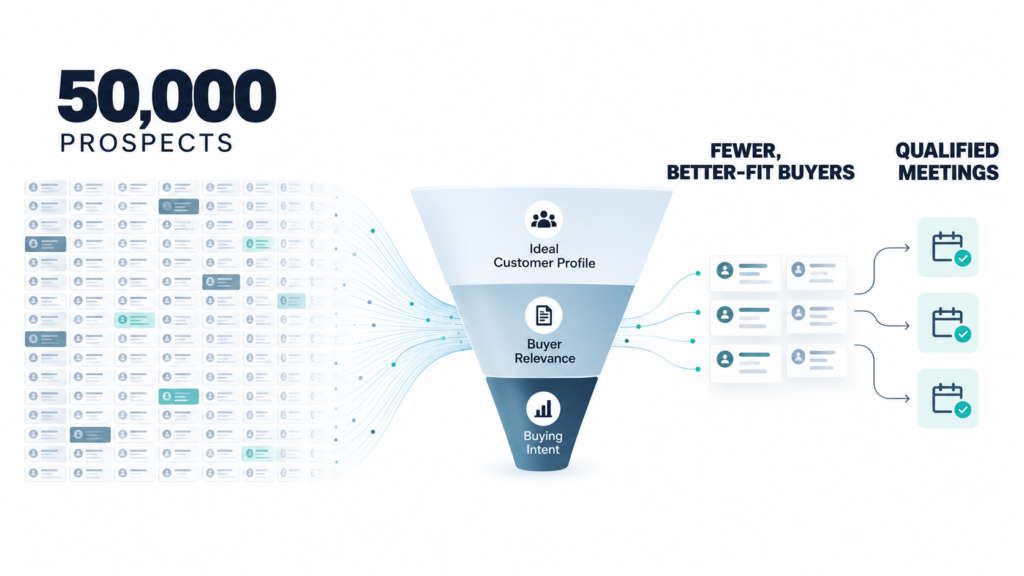
A technology company can have 50,000 prospects and still struggle to book qualified meetings. Often, the company is reaching the wrong people, leading with a generic message, or asking for a meeting before giving the buyer a reason to care. Cold Email Outreach for IT Companies works better when each email is part of a clear sales process, not just another activity on the calendar.
1. The Core Paradox: More Outreach Can Produce Less Pipeline
Imagine an IT services company offering cloud transformation. It has 20,000 contacts but very few qualified meetings. A company looking for basic IT support may have little interest in a complex cloud migration. A message sent to someone outside the buying process is unlikely to move forward.
Cold Email Outreach for IT Companies starts with relevance: who has the problem, why it matters now, and whether the business can help.
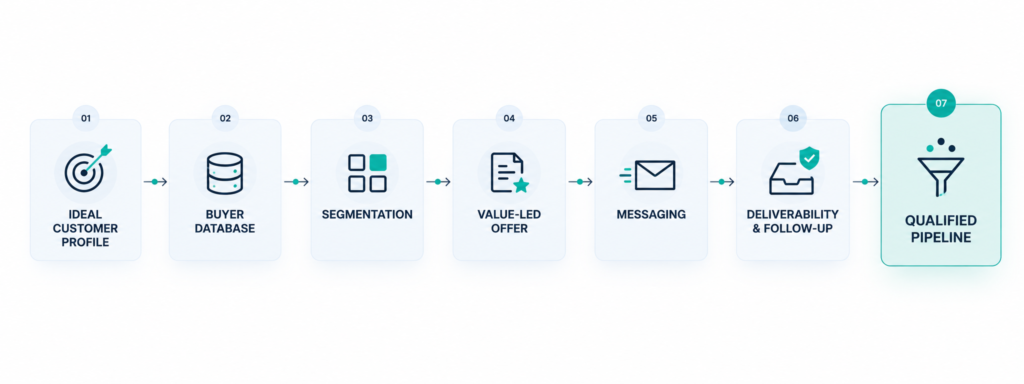
A useful process looks like this. It keeps Cold Email Outreach for IT Companies connected to the sales outcome:
Market → ICP → Data → Segmentation → Offer → Message → Sequence → Revenue
2. The Tactical Framework: From Market to Meeting
Step 1: Define the ICP Before Building the List
Before collecting email addresses, decide what a good-fit customer looks like. A cybersecurity SaaS provider, for example, might target North American SaaS companies with 200–1,000 employees, enterprise customers, and upcoming compliance requirements.
That is more useful than targeting every business that calls itself a technology company. A clear ideal customer profile (ICP) helps sales teams focus on accounts with a credible reason to buy. It gives Cold Email Outreach for IT Companies a much stronger starting point. Cold Email Outreach for IT Companies should also involve exclusion: if an account clearly does not fit, leave it out.
Step 2: Build a Buyer-Specific Database
Finding the right company is only part of the job. You also need to identify the people involved in the decision. In a cloud project, a CTO may approve the investment, engineering may deal with day-to-day issues, and Finance may review the budget.
Cold Email Outreach for IT Companies is more likely to start a useful conversation when the message reflects the recipient’s responsibilities.
Verify email addresses, check job titles, remove duplicates, and update outdated records.
Step 3: Segment Around Real Problems
Prospects in the same industry can have very different priorities. An IT services company might contact SaaS businesses entering enterprise markets, firms expanding into new countries, and companies growing their engineering teams.
Segment around the problem or buying trigger, not just the industry. This is what makes Cold Email Outreach for IT Companies feel relevant to each group. This gives Cold Email Outreach for IT Companies a specific point of view and makes personalization easier without writing every email from scratch.
Step 4: Offer a Useful Next Step
Think about what would make a prospect want to reply. Suppose an IT services provider notices SaaS companies expanding into Europe. Instead of immediately pitching a cloud migration project, it could offer a short infrastructure-readiness review. That gives Cold Email Outreach for IT Companies a clear purpose.
Cold Email Outreach for IT Companies is stronger when there is a credible reason to talk, not just a bigger promise.
Avoid claims you cannot support.
Step 5: Write for Busy Decision-Makers
Senior buyers rarely have time for long introductions and paragraphs of product features. Get to the point, explain why you are contacting them, and make the next step easy.
For example:
“Noticed your team has expanded into three new markets this year. That can put extra pressure on cloud governance. We recently helped a similar SaaS team identify gaps before they became infrastructure costs. Worth comparing notes?”
Cold Email Outreach for IT Companies should sound like one professional writing to another: clear, credible, and focused on a problem the recipient may recognize. Avoid inflated claims and vague lines such as “I’d love to pick your brain.” This keeps Cold Email Outreach for IT Companies direct and credible.
Step 6: Make Deliverability Part of the Process
A good copy cannot help if the email never reaches the inbox. If replies suddenly drop, check deliverability before rewriting every message.
Keep contact data clean, monitor bounces, and follow email-provider requirements and applicable regulations. These checks support Cold Email Outreach for IT Companies over the long term. Cold Email Outreach for IT Companies needs a sound technical foundation as well as relevant messaging.
Step 7: Use Follow-Ups to Add Something New
For a cybersecurity campaign, the first email might mention a compliance trigger. Each follow-up should add something useful, such as a common implementation gap, a relevant benchmark, or a question about how the company handles the issue today.
Over time, Cold Email Outreach for IT Companies should become a process the team learns from, not a fixed sequence sent to every list.
3. Measuring the Business Impact
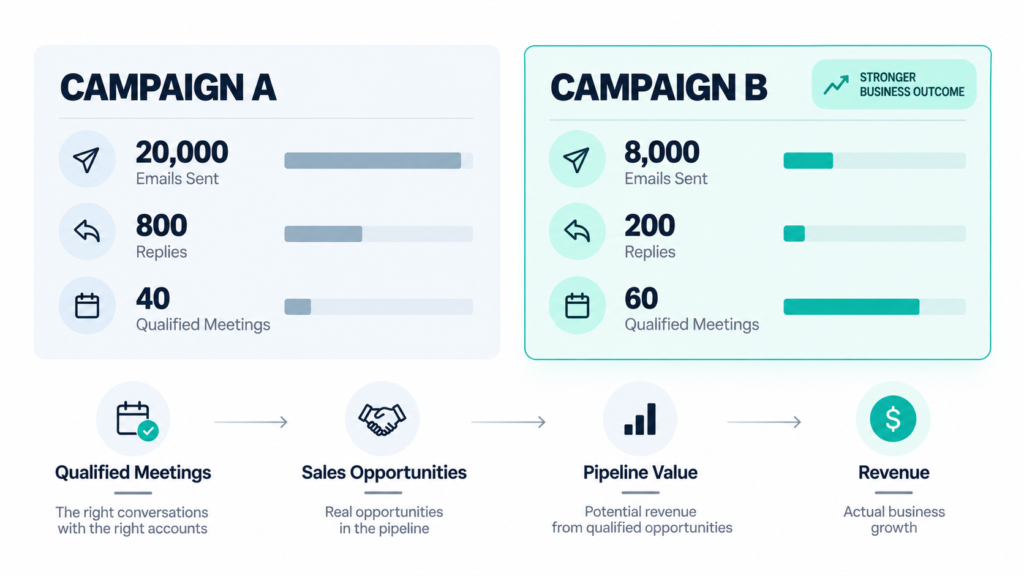
Reply volume alone can be misleading. Consider two campaigns:
- Campaign A: 20,000 emails → 800 replies → 40 qualified meetings.
- Campaign B: 8,000 emails → 200 replies → 60 qualified meetings.
Campaign B books more qualified meetings with fewer emails. If the goal is pipeline, that is a stronger result.
Measure deliverability, positive response rate, qualified meetings, opportunity conversion, pipeline value, customer acquisition cost (CAC), sales velocity, and revenue. These measures show whether Cold Email Outreach for IT Companies is contributing to the pipeline.
For Cold Email Outreach for IT Companies, the useful question is not just “How many people replied?” but “How many conversations moved the business forward?” Fewer replies can still mean better results if they come from suitable buyers and turn into opportunities.
4. The Strategic Takeaway
Cold Email Outreach for IT Companies works best when account selection, buyer research, messaging, deliverability, follow-up, and measurement work together.
Before increasing volume, check whether the target accounts fit your ICP, the message gives buyers a reason to respond, and the conversations become qualified opportunities.
If the answers are unclear, improve the process before sending more emails. Cold Email Outreach for IT Companies should earn its place by producing better conversations, not simply more activity. The aim is to start relevant conversations with buyers who have a reason to engage, and turn those conversations into a healthier pipeline.