

What Should Be Included in a Professional Cold Email Outreach Service? A Strategic Guide for B2B Leaders in 2027

1. The Strategic Reality of a Professional Cold Email Outreach Service
Imagine a technology company with an exceptional product, a competitive pricing model, and a capable sales team. It invests in paid advertising, publishes thought leadership content, and attends industry events. Yet, its sales pipeline remains inconsistent. The right decision-makers are difficult to reach, inbound enquiries fluctuate, and revenue forecasts become increasingly difficult to predict. A professional cold email outreach can help address this challenge by turning outbound communication into a predictable source of pipeline.
The problem may not be the product or the market. It may be the absence of a structured outbound growth strategy.
This is where a professional cold email outreach service becomes strategically important.
In 2027, B2B companies cannot afford to treat cold email as a volume-driven activity. Sending thousands of generic messages is not a growth strategy. Identifying the right prospects, understanding their business priorities, initiating relevant conversations, and converting those conversations into qualified sales opportunities is what drives measurable results.
Many organisations approach cold email as a numbers game. They purchase contact databases, prepare generic templates, and distribute thousands of messages hoping that a percentage of recipients will respond.
This approach confuses activity with commercial progress.
A campaign can achieve thousands of deliveries and generate hundreds of replies without producing a single sales-qualified meeting. Conversely, a carefully researched campaign targeting 200 relevant decision-makers can create meaningful enterprise conversations.
The difference lies in strategy and execution.
A professional cold email outreach service should function as an extension of an organisation’s sales and marketing strategy. Its purpose is to identify the right organisations, reach relevant stakeholders, communicate a compelling business proposition, and convert interest into measurable opportunities.
Consider a technology company offering AI-powered quality engineering services. Its ideal prospects may include CTOs, VPs of Engineering, Heads of QA, and technology directors at mid-market and enterprise software organisations.
Sending the same message to every technology professional would be inefficient. Each stakeholder has different priorities, responsibilities, and purchasing influence.
Effective outreach recognises these differences and builds communication around them.
2. What Should a Professional Cold Email Outreach Service Include?
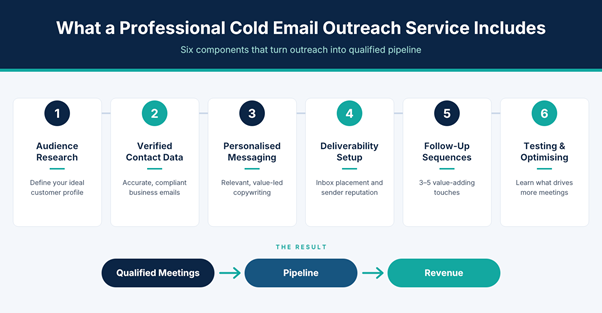
2.1 ICP Research for Effective Cold Email Outreach
Every successful outreach campaign begins with a clear understanding of whom the business wants to reach.
A professional cold email outreach service should define the Ideal Customer Profile (ICP) using factors such as:
- Industry and business vertical.
- Company size and annual revenue.
- Geographic location and target markets.
- Technology stack and business requirements.
- Decision-makers and purchasing authority.
- Potential business challenges and buying signals.
For example, an AI quality engineering company may target CTOs, VPs of Engineering, and Heads of QA at enterprise software companies experiencing increasing testing complexity.
This research prevents sales teams from wasting resources on prospects who have little relevance to the solution.
2.2 Verified B2B Contact Database Building for Cold Email Outreach
Even the strongest outreach strategy fails when the underlying contact database is inaccurate.
A professional cold email outreach service should include prospect identification, business email discovery, and email verification.
The database should capture:
- Full name and professional designation.
- Company name and website.
- Verified business email address.
- LinkedIn profile.
- Industry and company size.
- Relevant business context.
Accurate contact information helps reduce hard bounces and protects sender reputation. Data should also be sourced, stored, and processed in accordance with applicable privacy and data protection requirements.
The objective is not to build the largest database. It is to build the most relevant one.
2.3 Email Copywriting and Personalization for Cold Outreach
Personalization is not simply inserting someone’s first name into an email.
A meaningful message demonstrates an understanding of the recipient’s business priorities, operational challenges, or growth objectives.
A professional cold email outreach service should develop messaging around five elements:
- Relevant opening: Establish why the recipient is being contacted.
- Business challenge: Identify a problem relevant to their organisation.
- Value proposition: Explain how the solution addresses that challenge.
- Credibility: Introduce relevant expertise, experience, or a supporting proof point.
- Call to action: Suggest a simple next step, such as a short discovery conversation.
For example, instead of saying, “We provide AI-powered software testing services,” a stronger message could explain how the organisation can improve release confidence while reducing repetitive testing effort.
The objective is to make the conversation relevant before making the sales pitch.
2.4 Email Infrastructure and Deliverability Management for Cold Email Campaigns
A well-written email is worthless if it consistently lands in spam.
A professional cold email outreach service should include technical infrastructure management covering:
- Dedicated sending domains and appropriate DNS configuration.
- SPF, DKIM, and DMARC authentication.
- Domain reputation monitoring.
- Bounce-rate management.
- Sending-volume controls.
- Inbox placement monitoring.
Campaigns should follow responsible sending practices and applicable email regulations. Where domain warming is appropriate, it should focus on establishing legitimate sending patterns rather than artificially manipulating engagement.
Deliverability is not a one-time setup. It requires continuous monitoring, maintenance, and optimisation.
2.5 Multi-Step Follow-Up Sequences for B2B Cold Email Outreach
Most B2B prospects do not respond to the first email. This does not automatically indicate a lack of interest.
A structured follow-up sequence ensures that potential opportunities are not lost simply because the initial message went unanswered.
A typical sequence could include:
- Email 1 – Introduction: Present the business challenge and value proposition.
- Email 2 – Industry Insight: Share a relevant observation or useful insight.
- Email 3 – Business Outcome: Introduce a customer outcome or practical use case.
- Email 4 – Conversation: Offer a straightforward discovery conversation.
- Email 5 – Closing: Send a polite final message.
Each follow-up should introduce additional value rather than repeat the same sales pitch. Prospects who decline or opt out must be excluded from further outreach.
2.6 Cold Email Campaign Execution and Performance Optimisation
A professional cold email outreach service should manage campaign execution and continuously evaluate performance.
This includes audience segmentation, controlled messaging experiments, sequence management, response categorisation, and campaign adjustments.
For example, a campaign targeting CTOs may perform differently from one targeting Heads of Procurement. Similarly, a message focused on operational efficiency may generate different responses from one focused on cost reduction.
Testing these variables helps identify what resonates with specific audiences.
The objective is not simply to increase email activity. It is to understand which audiences, value propositions, and messages generate meaningful business conversations.
3. Measuring the Business Impact of Cold Email Outreach Services
For executive leadership, the value of a professional cold email outreach service should be evaluated through commercial outcomes rather than email activity alone.
Key Metrics for Measuring Cold Email Performance
Metric | What It Measures |
Delivery rate | Successful email delivery |
Bounce rate | Quality of contact data |
Positive reply rate | Relevant prospect interest |
Meeting booking rate | Ability to generate conversations |
Sales-qualified meetings | Opportunities meeting sales criteria |
Cost per qualified meeting | Acquisition efficiency |
Pipeline generated | Potential commercial value |
Customer acquisition cost | Overall acquisition economics |
Measuring Campaign Results Through Business Outcomes
If the campaign generates 40 positive responses, 15 discovery meetings, and eight sales-qualified opportunities, leadership has a clearer picture of its commercial contribution.
The next step is connecting those opportunities to pipeline value, conversion rates, and eventual customer lifetime value (LTV).
This creates accountability between marketing investment and revenue generation.
Understanding the Limitations of Email Open Rates. because email privacy features and automated activity can distort the numbers.
The ultimate measure of success is whether outreach contributes to qualified pipeline and profitable customer acquisition.
4. Building a Pipeline with a Professional Cold Email Outreach Service
The real value of a professional cold email outreach service lies in the system behind every message.
Audience intelligence identifies the right buyers. Verified contact data establishes a reliable foundation. Personalised messaging creates relevance. Deliverability infrastructure protects communication channels. Follow-up sequences build continuity. Performance analytics connect outreach activity to commercial outcomes.
For B2B technology companies, cold email should not operate independently of the broader growth strategy.
Integrating it with LinkedIn outreach, content marketing, paid advertising, and CRM workflows can create a more coordinated demand-generation engine.
As enterprise buying journeys become increasingly complex in 2027, businesses need more than isolated marketing campaigns. They need a repeatable process for reaching decision-makers, establishing credibility, and creating sales opportunities.
The question for leadership is no longer how many emails can be sent in a month.
It is how consistently the organisation can turn relevant prospects into qualified conversations and measurable pipeline.
That is the difference between sending cold emails and building a scalable outbound growth strategy.
Frequently Asked Questions (FAQs)
1. What is included in a professional cold email outreach service?
It typically includes ICP research, prospect database building, email verification, campaign copywriting, personalization, email infrastructure setup, deliverability management, follow-up sequences, campaign execution, and performance reporting.
2. How does cold email outreach generate B2B leads?
Cold email outreach identifies relevant decision-makers, introduces solutions to their business challenges, and encourages conversations. Interested prospects can then move into discovery calls and the sales qualification process.
3. How many follow-up emails should a B2B campaign include?
A typical campaign may include three to five carefully spaced follow-ups. The appropriate number depends on the audience, sales cycle, and campaign response. Every sequence should respect opt-outs and applicable communication regulations.
4. How do you measure the success of cold email campaigns?
Success should be measured through positive reply rates, booked meetings, sales-qualified opportunities, cost per qualified meeting, pipeline generated, and eventual revenue contribution.
5. Is cold email outreach effective for IT and technology companies?
Yes. It can help IT and technology companies reach CTOs, CIOs, technology directors, engineering leaders, and other decision-makers who may not actively search for their services. Its effectiveness depends on targeting accuracy, relevant messaging, responsible execution, and continuous optimisation.
6. How is a professional cold email outreach service different from bulk email marketing?
Bulk email marketing generally distributes messages to larger subscriber or contact lists. Professional cold email outreach focuses on identifying specific business prospects and initiating relevant one-to-one conversations through targeted, personalised communication.
7. How long does it take to see results from cold email outreach?
Initial engagement signals may emerge within the first few weeks, but meaningful pipeline results depend on campaign quality, audience responsiveness, sales cycles, and follow-up execution. Enterprise sales opportunities may take considerably longer to convert into revenue.