

The Difference Between Lead Generation and Qualified Pipeline Generation
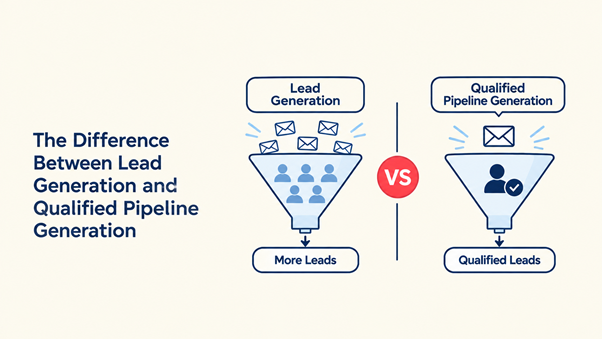
The short answer: Lead generation measures how many contacts enter your funnel. Qualified pipeline generation measures how many real buying conversations, with a decision-maker, a named problem, and a plausible timeline, become sales opportunities. Leads signal interest. Qualified pipeline signals revenue potential.
The Core Paradox: Lead Generation vs Qualified Pipeline Generation
A CMO at a mid-market IT services firm walks into her board meeting with a triumphant slide: 1,200 new leads, up 60 percent. Then the CRO speaks. However, pipeline is flat, and only two deals closed. As a result, the room goes quiet, because both numbers are true.
That silence is the heart of lead generation vs qualified pipeline generation. One is a volume metric. In contrast, the other is a leading indicator of revenue. Therefore, organizations that blur the two do not have a lead problem. Instead, they have a definition problem. Sellers chase contacts who never intended to buy, and win rates sag. Consequently, leadership concludes the market is soft when the real culprit is the scoreboard.
What Is B2B Lead Generation?
B2B lead generation is the work of attracting and capturing contact information from people who might someday buy. For example, it includes content downloads, webinar registrations, event scans, form fills, and list-based outreach. Its natural unit of success is the contact, and its natural owner is marketing.
Lead generation is necessary. After all, without it, there is nothing to qualify. However, the risk is treating it as the finish line. For instance, a whitepaper download from a junior analyst is a contact, not a commitment.
What Is Qualified Pipeline Generation?
Qualified pipeline generation is the discipline of turning contacts and target accounts into sales opportunities that meet agreed criteria: a confirmed business problem, access to budget authority, a realistic timeline, and fit with your ideal customer profile. Put simply, B2B pipeline generation is judged by conversations that happened, not forms that were filled.
| Lead generation | Qualified pipeline generation | |
|---|---|---|
| Unit of success | Contacts captured | Sales-qualified meetings and opportunities |
| Core question | Who showed interest? | Who can buy, and why now? |
| Owner | Marketing | Marketing, SDRs, and sales together |
| Primary metric | Cost per lead | Cost per qualified opportunity |
| Failure mode | Full funnel, empty quarter | Slower volume, higher confidence |
Why Qualified Pipeline Generation Matters More for IT Companies
For lead generation for IT companies, the stakes are higher because enterprise technology purchases are collective decisions. In fact, Gartner research finds that the typical buying group for a complex B2B solution involves six to ten decision-makers. Moreover, buyers spend only about 17 percent of their purchase process meeting with potential suppliers, and that share is divided across every vendor they evaluate.
The implication is uncomfortable. First, a single enthusiastic contact rarely represents a buying decision. Second, you have a narrow window to earn a seat in the conversation. Therefore, counting that contact as pipeline inflates forecasts and burns your sales team’s scarcest resource: attention. For this reason, qualified pipeline generation, not raw lead volume, should drive IT sales planning.
Tactical Framework: Four Mechanics of Qualified Pipeline Generation
Turning volume into qualified pipeline requires a system, not a campaign. Accordingly, build these four mechanics in order.
1. Define “Qualified” in Writing
Most B2B lead qualification fails because marketing and sales hold different definitions. Therefore, agree on the criteria before launch and document them. That way, a sales qualified lead means the same thing in every pipeline review. Fortunately, the next section gives a starting standard.
2. Start From Accounts, Not Forms
Effective B2B prospecting begins with a defined list of accounts showing trigger events: a new CIO, a cloud migration deadline, or a compliance mandate. In addition, a deliberate outbound sales strategy reaches buyers before they have shortlisted anyone. As a result, B2B outbound lead generation surfaces qualified B2B leads that inbound forms rarely capture.
3. Qualify Through Conversation, Not Scoring Alone
Lead scores help you prioritize, but they cannot confirm intent. Instead, a short discovery call separates curiosity from need. This is where B2B appointment setting earns its keep, because the goal is a meeting the seller wants to attend, not a calendar padded with courtesy calls. Whether you build SDRs in-house or partner for IT services lead generation, hold the standard constant.
4. Close the Feedback Loop Weekly
Each week, sales reports which meetings were genuine, and then marketing adjusts targeting and messaging. Otherwise, even a thoughtful lead generation strategy drifts toward what is easy to count instead of what converts. In that case, qualified pipeline generation stalls.
How to Define a Sales Qualified Lead
A workable standard has four tests. Specifically, a contact becomes a sales qualified lead only when all four are true:
- Problem: The buyer can name a specific business or technical problem you solve.
- Authority: A decision-maker is involved, or the contact can credibly reach one.
- Timeline: There is a trigger or deadline that makes action plausible within a defined window.
- Fit: The account matches your ideal customer profile by size, industry, and technology environment.
Similarly, established frameworks such as BANT and MEDDIC cover similar ground in more depth. Pick one, adapt it to your sales cycle, and apply it consistently. After all, consistency matters more than the acronym.
Consider an illustrative comparison (hypothetical numbers). First, a broad campaign delivers 500 leads and a 2 percent lead-to-meeting rate, which means ten meetings. Second, a targeted program works 60 chosen accounts and books eight meetings, each with a confirmed problem and a decision-maker present. Although the first program looks larger, the second delivers stronger qualified pipeline generation at a lower cost per opportunity.
Metric-Driven Impact: How to Measure Qualified Pipeline Generation
Cost per lead is the most flattering and least useful number in marketing. Because it falls whenever you loosen your criteria, it rewards the wrong behavior. Instead, replace it with a scorecard built for sales pipeline development:
- Sales-qualified meetings per month: the earliest proof that qualified lead generation is working.
- Lead-to-opportunity conversion: the share of leads that become real deals. Notably, a falling rate signals qualification drift.
- Cost per qualified opportunity: total program spend divided by opportunities created.
- Pipeline velocity: (opportunities × average deal size × win rate) ÷ sales cycle length.
- Pipeline coverage: open pipeline relative to quota, calibrated against your own win rate.
Together, these metrics show whether your pipeline generation strategy creates value or merely activity. Furthermore, they make a B2B sales pipeline forecast defensible to a board, because every stage rests on a conversation that happened. Finally, track them monthly alongside CAC and LTV, and the link between marketing spend and revenue becomes arithmetic.
Frequently Asked Questions About Qualified Pipeline Generation
What is the difference between lead generation and qualified pipeline generation?
Lead generation captures contacts who show interest. By contrast, qualified pipeline generation converts the right accounts into opportunities that meet defined criteria for problem, authority, timeline, and fit. In short, the first measures volume, while the second measures revenue potential.
What is a sales qualified lead?
A sales qualified lead is a contact that sales has reviewed and accepted against agreed criteria. Typically, these criteria include a confirmed problem, access to a decision-maker, a plausible timeline, and fit with the ideal customer profile.
What is a good lead-to-opportunity conversion rate?
It varies widely by industry, deal size, and lead source. Therefore, benchmark against your own history first. In addition, a steady decline usually signals that qualification standards are slipping.
Should IT companies use outbound or inbound for qualified pipeline generation?
Most mature IT firms use both. On one hand, inbound captures existing demand. On the other hand, outbound creates conversations with accounts you choose. As a result, outbound gives you control over timing and target.
The Strategic Takeaway: Count Conversations, Not Contacts
Return to that boardroom. Clearly, the CMO was not wrong to celebrate volume. Rather, she was wrong to present it as progress toward revenue.
Here is your assignment this week. First, pull last quarter’s lead report. Then, strike every contact with no meeting, no named problem, and no decision-maker. What remains is your real pipeline, and its size is the number that matters.
In short, leads are the raw material, and qualified pipeline is the product. Therefore, the companies that grow predictably are the ones that know the difference and invest in qualified pipeline generation accordingly.